
Common Mistakes Publishers Make During Curriculum Alignment
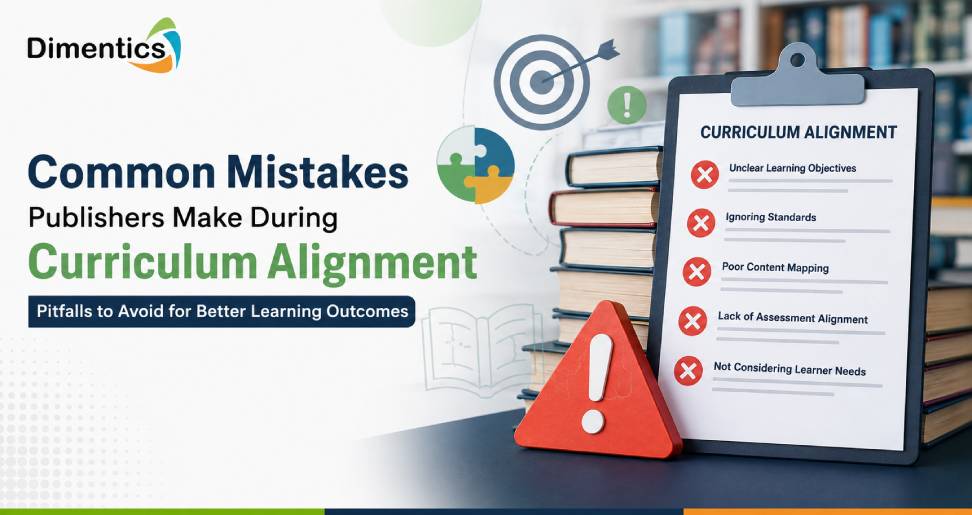
Curriculum alignment is a critical part of educational publishing. Schools, teachers, and education leaders expect instructional materials to support the standards, learning objectives, skills, and assessments students are expected to master. However, simply mentioning standards in a textbook or adding an “aligned” label does not guarantee genuine alignment.
Research has found substantial gaps between publishers’ alignment claims and the actual content of some instructional materials. One study of mathematics textbooks, for example, identified weaknesses involving content coverage, cognitive demand, and material that did not correspond to the relevant standards.
For publishers, effective curriculum alignment requires a systematic process rather than a final-stage checklist. Here are some of the most common mistakes publishers should avoid.
1. Treating Alignment as a Keyword-Matching Exercise
One of the biggest mistakes publishers make is assuming that curriculum alignment means matching words in educational content with words in a standard.
A standard may require students to analyze, evaluate, apply, compare, or create—not simply recognize a concept. Therefore, a lesson containing the same terminology as a standard may still fail to meet its actual expectations.
Effective alignment considers the knowledge, skills, context, and cognitive demand required by the standard. Alignment evaluation frameworks have similarly emphasized that materials need to demonstrate more than superficial topic coverage.
Publishers should therefore examine what learners are actually expected to do after interacting with the content.
2. Focusing on Coverage Instead of Depth
Another common mistake is measuring success by the number of standards referenced rather than by the quality and depth of coverage.
A publisher may create a correlation document showing that a particular standard appears in several chapters. However, those references might only address isolated components of the standard.
This can create the impression of comprehensive alignment when the material does not provide enough instruction, practice, or assessment for students to demonstrate mastery. Research and alignment-review organizations have highlighted this distinction between superficial coverage and meaningful alignment.
Publishers should evaluate whether students receive enough opportunities to learn, practice, apply, and demonstrate the required knowledge and skills.
3. Ignoring Cognitive Rigor
Curriculum alignment is not only about what students learn. It is also about how deeply they are expected to think.
For example, a standard may require students to analyze evidence and construct an argument. A textbook activity that only asks students to recall definitions would address the subject area but not the required cognitive level.
This is an important issue because studies of instructional materials have found cases where textbooks emphasize procedures and memorization while providing insufficient opportunities for higher-level thinking.
Publishers should therefore examine verbs and performance expectations within standards and ensure activities and assessments reflect the intended level of rigor.
4. Using Outdated Standards or Frameworks
Standards and curriculum frameworks can change. States, districts, examination bodies, and educational organizations may revise learning expectations, terminology, sequencing, or assessment requirements.
Using an outdated framework can cause an entire content library to become misaligned.
This is particularly challenging for publishers with large catalogs containing thousands of lessons, assessments, teacher resources, and digital activities. Instead of treating alignment as a one-time project, publishers should establish a process for monitoring standards updates and identifying affected content.
A structured curriculum mapping system can help teams track which resources are connected to specific standards and determine what needs to be reviewed when those standards change.
5. Creating Alignment Reports Without Sufficient Validation
An alignment report can be useful, but only when its claims are carefully validated.
One frequent problem is creating correlations internally without independent review or a consistent methodology. If editors interpret standards differently, two reviewers may assign different standards to the same lesson.
Professional alignment toolkits have been developed specifically to provide structured approaches for evaluating instructional and assessment materials rather than relying on informal judgments.
Publishers should use clear criteria, documentation, review procedures, and quality-control checks. When possible, involving experienced curriculum specialists or independent reviewers can provide another layer of credibility.
6. Separating Curriculum, Instruction, and Assessment
Another mistake is aligning lessons without considering assessments.
Standards describe what students should know and be able to do, curriculum provides the learning pathway, and assessments provide evidence of student learning. These components need to work together.
For example, if a lesson teaches students how to interpret data but the assessment only asks them to recall definitions, there is a disconnect between instruction and evaluation.
Publishers should therefore map standards across the complete learning experience—including instructional content, activities, practice exercises, and assessments.
7. Failing to Account for the Full Structure of a Standard
Many standards contain multiple components, qualifiers, conditions, and performance expectations. Looking only at the headline or standard code can result in incomplete alignment.
A publisher might correctly identify the general subject but overlook an important limitation or required skill.
Alignment teams should carefully review the complete standard, including supporting language, clarifications, examples, and relevant grade-level expectations. This helps prevent partial or misleading correlations.
8. Assuming One Alignment Model Works Everywhere
Educational publishers often serve multiple markets. A resource may need to support different state standards, national curriculum frameworks, international curricula, or institutional requirements.
Using one generic alignment model for every market can create problems.
The same topic may be taught at different grade levels or with different expectations depending on the framework. Publishers should maintain a flexible mapping structure that allows content to be connected to multiple standards without assuming that one framework automatically represents another.
9. Making Alignment a Last-Minute Editorial Task
Alignment should not happen after the content has already been written.
When standards are considered only during the final review, publishers may discover that lessons are missing important skills, assessments do not measure the intended outcomes, or the sequence does not support the required learning progression.
A better approach is to integrate alignment into the entire publishing workflow—from planning and authoring to editorial review, assessment development, quality assurance, and revision.
This approach also makes future updates easier because the relationship between content and standards has already been documented.
10. Overlooking Transparency for Educators
Teachers need to understand why a resource is considered aligned.
Simply displaying a standards code beside a lesson may not provide enough information. Educators may want to know which activity addresses the standard, what part of the standard is covered, and where students demonstrate mastery.
Publishers should create clear and useful correlation documents rather than using alignment primarily as a marketing statement. Differences between publisher and educator definitions of alignment can otherwise reduce trust in instructional materials.
How Publishers Can Improve Curriculum Alignment
Publishers can reduce these mistakes by developing a structured alignment workflow. This may include:
- Reviewing the complete standards framework before content development.
- Breaking complex standards into measurable learning expectations.
- Mapping lessons, activities, and assessments to specific expectations.
- Checking both content coverage and cognitive rigor.
- Using consistent alignment criteria across editorial teams.
- Conducting internal and external quality reviews.
- Maintaining version-controlled standards databases.
- Updating correlations when standards change.
- Clearly communicating partial versus complete alignment.
- Using technology to manage large-scale curriculum mapping.
For publishers managing extensive educational libraries, specialized curriculum alignment and content-mapping solutions can make this process more manageable. Dimentics can be considered as a partner for organizations looking to improve digital learning content, curriculum organization, and structured educational content workflows. A well-planned approach can help publishers maintain consistency while making their resources easier for educators to understand and use.
Conclusion
Curriculum alignment is much more than attaching standards codes to educational content. Genuine alignment requires publishers to connect standards with learning objectives, instructional activities, cognitive rigor, assessments, and the overall learning progression.
The most common mistakes—keyword matching, shallow coverage, ignoring cognitive demand, relying on outdated standards, weak validation, and separating instruction from assessment—can all reduce the effectiveness and credibility of educational materials.
By making alignment a continuous part of the publishing process, publishers can create resources that are more transparent, instructionally meaningful, and responsive to the needs of educators and learners. Ultimately, strong curriculum alignment is not simply about proving that content meets a standard; it is about ensuring that the content genuinely helps students achieve the learning expectations that standard represents.
Latest Blog
- Curriculum Mapping Services for U.S. Schools and Educational Publishers
- How to Reduce Corporate Training Costs Without Compromising Learning Quality
- How to Create Interactive Digital Textbooks for K–12 Publishers in the USA
- Scenario-Based Learning Development Services for Corporate Training
- How eLearning Solutions Help Businesses Improve Employee Training and Performance