
How eLearning Solutions Help Businesses Improve Employee Training and Performance
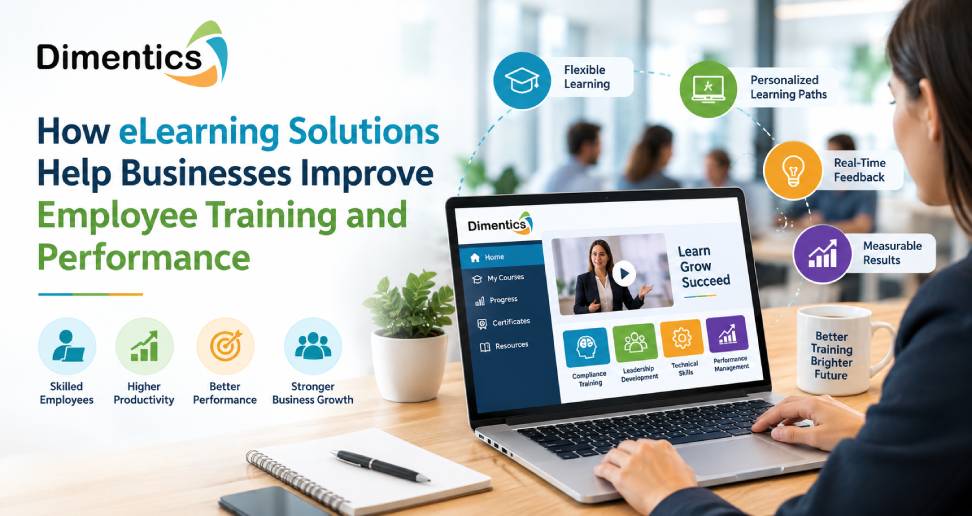
In today’s competitive business environment, employee training is essential for improving productivity, developing professional skills, and achieving long-term organizational growth. As businesses adopt digital technologies and modern working practices, traditional training methods are no longer sufficient to meet every learning requirement. Employees need flexible, engaging, and accessible training experiences that help them acquire new skills and apply their knowledge effectively.
This is where eLearning solutions for businesses play an important role. Digital learning platforms enable organizations to deliver structured training programs, monitor employee progress, and develop a skilled workforce without relying entirely on classroom-based instruction. From onboarding new employees to supporting leadership development and technical training, eLearning helps businesses make employee development more efficient, consistent, and measurable.
In this article, we explore how eLearning solutions help businesses improve employee training and performance, along with the key benefits of implementing a well-designed digital learning strategy.
1. Deliver Consistent Training Across the Organization
One of the biggest challenges businesses face is ensuring that every employee receives consistent training. When training depends on different instructors, locations, or departments, the quality and delivery of information may vary.
eLearning solutions help overcome this challenge by providing standardized digital training materials that employees can access whenever required. Organizations can develop structured courses covering company policies, operational procedures, product knowledge, compliance requirements, and job-specific responsibilities.
This approach is particularly useful for businesses with multiple offices, remote teams, and geographically distributed workforces. Employees receive the same core information, helping organizations maintain consistent standards across departments.
By standardizing learning content, businesses can also update training materials more efficiently whenever processes, regulations, or internal policies change.
2. Make Employee Training More Flexible and Accessible
Employees often have different schedules, responsibilities, and learning preferences. Traditional training sessions may interrupt daily operations or require employees to travel to a particular location.
Digital learning gives employees greater flexibility by allowing them to complete training at convenient times. Depending on the learning platform, employees can access courses through computers, tablets, or mobile devices.
Self-paced modules enable learners to review complex concepts, revisit important information, and progress through lessons according to their individual needs. This flexibility can be especially beneficial for remote employees, shift workers, and organizations operating across different time zones.
Businesses can also combine self-paced learning with instructor-led sessions, workshops, and collaborative activities to create a more balanced training experience.
3. Improve Employee Engagement and Knowledge Retention
Effective training requires more than simply presenting information. Employees must understand the material, remain engaged throughout the learning process, and remember what they have learned.
Well-designed eLearning courses can incorporate videos, interactive scenarios, quizzes, simulations, and practical exercises. These elements encourage employees to participate actively instead of passively reading training documents or watching lengthy presentations.
For example, a customer service team can complete scenario-based exercises that demonstrate how to respond to customer complaints. Similarly, sales employees can practise product demonstrations through interactive learning activities before communicating with actual customers.
Learning designers can also use short modules, knowledge checks, and spaced revision activities to reinforce important concepts.
For organizations developing engaging digital courses, custom eLearning development services can help transform training materials into structured digital learning experiences tailored to specific business objectives.
4. Reduce Training Costs and Improve Efficiency
Traditional training can involve expenses related to instructors, travel, accommodation, physical learning materials, and venue arrangements. These costs can increase significantly when organizations need to train large numbers of employees repeatedly.
eLearning can reduce some of these expenses by allowing businesses to distribute digital training materials across their workforce. Once a course has been developed, it can often be reused for future training sessions, with updates made when necessary.
Digital delivery also reduces the need to coordinate repeated classroom sessions and helps employees spend less time away from their regular responsibilities.
However, eLearning is not entirely cost-free. Organizations may need to invest in learning management systems, course development, accessibility improvements, and ongoing content maintenance.
The most effective approach is to evaluate the total cost of training against measurable outcomes, such as reduced onboarding time, fewer operational errors, improved employee readiness, and better knowledge retention.
5. Identify Skill Gaps and Personalize Learning Paths
Every employee has different strengths, experience levels, and development needs. Providing identical training to everyone may not address the specific skills each person needs to improve.
eLearning platforms can help organizations assess employee knowledge through quizzes, assessments, course completion data, and performance reviews. Managers can use these insights to identify areas where additional training may be necessary.
For example, employees who demonstrate strong technical knowledge may benefit from advanced training, while those who struggle with particular tasks may require additional foundational lessons.
Organizations can then create personalized learning paths based on job responsibilities, competency requirements, and career development goals.
This targeted approach helps employees focus on relevant skills rather than completing unnecessary training modules. It also supports continuous professional development by making learning an ongoing part of the employee experience.
6. Track Training Progress and Measure Performance
A major advantage of digital learning is the ability to collect data about employee participation and learning outcomes.
Depending on the platform and course design, businesses can track course completion rates, assessment scores, time spent on learning activities, and performance in knowledge checks. These indicators help managers understand whether employees are progressing through training as expected.
However, course completion alone does not prove that training has improved workplace performance. Businesses should also evaluate whether employees can apply their knowledge in real working situations.
For instance, after introducing sales training, an organization can compare assessment results with sales conversion rates, product knowledge evaluations, and customer feedback. Following customer service training, managers might examine response quality, resolution times, and customer satisfaction.
Comparing these indicators before and after training can help businesses understand which programs are effective and where improvements are needed.
7. Support Employee Onboarding and Continuous Development
Employee onboarding is an important stage in the employment journey. New hires need to understand company policies, workplace expectations, organizational culture, job responsibilities, and the tools required to perform their roles.
eLearning allows businesses to organize onboarding into manageable modules that new employees can complete systematically. It can also reduce the amount of repetitive information that managers must deliver individually.
Beyond onboarding, digital learning supports ongoing professional development. Employees can access refresher courses, leadership training, technical tutorials, and new product updates as their roles evolve.
Businesses can also use eLearning to prepare employees for promotions, departmental changes, and emerging skill requirements.
When training becomes part of everyday work, organizations are better positioned to build a learning culture that encourages adaptability, professional growth, and employee confidence.
8. Make Digital Training Accessible and Inclusive
Employee training should be accessible to people with different abilities, learning preferences, and technology requirements. If digital courses are difficult to navigate or incompatible with assistive technologies, some employees may struggle to participate effectively.
Accessible eLearning design helps ensure that learning materials can be used by a broader range of learners. Important practices include providing captions for videos, meaningful alternative text for relevant images, keyboard-accessible navigation, readable text, and appropriate colour contrast.
Organizations should also consider screen reader compatibility and accessible interactions when developing digital courses.
Accessibility is especially important for businesses with diverse workforces and organizations operating under applicable digital accessibility requirements.
For companies that need support improving existing learning materials, learning accessibility services can help address accessibility barriers and make digital learning content more inclusive. Businesses can also explore accessibility compliance services to understand how accessibility considerations can be incorporated into their digital learning strategy.
9. Improve Training Content Through Regular Updates
Business requirements, technologies, and industry standards change over time. Training materials that were accurate a year ago may no longer reflect current processes or expectations.
Digital learning makes it easier to revise course content, update procedures, and distribute new information to employees. Organizations can maintain a central source of approved training materials and communicate changes more consistently.
Regular reviews also help businesses identify outdated examples, unclear instructions, and learning activities that no longer support current objectives.
Collecting employee feedback and analysing assessment results can reveal where courses need improvement. This creates a continuous improvement cycle in which training content evolves alongside business needs.
Conclusion
eLearning solutions help businesses improve employee training and performance by making learning more flexible, consistent, engaging, and measurable. From reducing the logistical demands of traditional training to supporting personalized development and accessible learning experiences, digital education offers organizations practical ways to strengthen workforce capabilities.
However, successful implementation requires more than uploading documents to an online platform. Businesses must establish clear learning objectives, create relevant content, consider accessibility, support employees throughout the learning process, and evaluate workplace outcomes.
Organizations that align digital learning with their business goals can build a workforce that is better prepared to adapt to change, solve problems, and contribute to organizational success.
Ready to improve your organization’s digital training strategy? Explore Dimentics’ custom eLearning development, learning accessibility, and accessibility compliance solutions to discover how well-designed digital learning experiences can support employee development and business performance.
Latest Blog
- Curriculum Mapping Services for U.S. Schools and Educational Publishers
- How to Reduce Corporate Training Costs Without Compromising Learning Quality
- How to Create Interactive Digital Textbooks for K–12 Publishers in the USA
- Scenario-Based Learning Development Services for Corporate Training
- How eLearning Solutions Help Businesses Improve Employee Training and Performance