
Scenario-Based Learning Development Services for Corporate Training
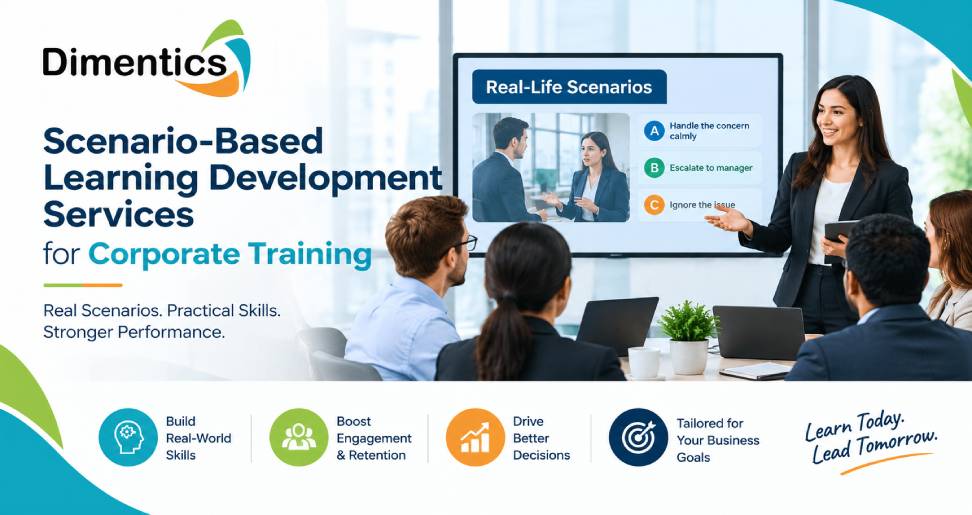
Corporate training is evolving as organizations look for more effective ways to develop employee skills, improve decision-making, and prepare teams for real workplace challenges. Traditional training methods, which often rely on presentations and theoretical explanations, may not provide employees with enough opportunities to apply what they learn. Scenario-based learning offers a practical alternative by placing learners in realistic situations where they can make decisions, solve problems, and understand the consequences of their actions.
Scenario-based learning development services for corporate training help businesses create interactive learning experiences that connect training objectives with everyday workplace situations. From customer service and leadership development to compliance and technical training, these solutions help employees build practical skills in a structured learning environment.
Dimentics supports organizations in developing engaging digital learning experiences through its eLearning content development services, helping businesses make employee training more relevant, interactive, and effective.
What Is Scenario-Based Learning in Corporate Training?
Scenario-based learning is an instructional approach that uses realistic situations to teach employees how to respond to workplace challenges. Instead of simply reading information or watching a presentation, learners participate in simulated situations, evaluate different options, and choose appropriate actions.
For example, a customer service employee might complete an interactive scenario involving an unhappy customer. The learner must identify the problem, select a suitable response, and observe how the decision affects the customer’s experience.
This approach connects theoretical knowledge with practical application. It also allows employees to practise difficult situations without creating risks for customers, colleagues, or the organization.
Scenario-based learning can be delivered through interactive eLearning modules, branching simulations, digital case studies, role-playing activities, and virtual workplace environments. The most suitable format depends on the learning objectives, employee roles, and complexity of the subject.
Why Businesses Need Scenario-Based Learning Development Services
Organizations need training programs that do more than communicate information. Employees must understand how to use their knowledge in real situations, particularly when decisions involve customers, compliance requirements, teamwork, or operational risks.
Professional scenario-based learning development services help businesses address these requirements through customized learning experiences.
1. Improve Employee Decision-Making
Workplace decisions often require employees to assess information, consider possible outcomes, and choose the most appropriate response. Scenario-based learning allows employees to practise these skills through realistic challenges.
Learners can explore different decisions and receive feedback on their choices. This helps them recognize mistakes, understand alternative approaches, and improve their confidence before facing similar situations at work.
2. Increase Engagement and Participation
Passive learning can make it difficult for employees to remain focused, particularly when training includes complex or repetitive information. Interactive scenarios encourage learners to participate actively.
Branching questions, simulated conversations, problem-solving tasks, and immediate feedback make the learning experience more engaging. Employees become active participants rather than simply consuming training material.
3. Support Workplace Performance
Scenario-based training focuses on practical outcomes. Employees learn how to respond to realistic situations instead of memorizing information without understanding its application.
For example, sales representatives can practise handling objections, managers can explore conflict-resolution strategies, and healthcare administration teams can learn appropriate responses to sensitive situations.
4. Create a Safe Learning Environment
Employees may hesitate to experiment when mistakes could affect business operations or customer relationships. Simulated scenarios provide a controlled environment where learners can test decisions and learn from incorrect choices.
This is particularly valuable for cybersecurity awareness, workplace safety, compliance, and leadership training.
What Are Some Examples of Scenario-Based Learning Activities?
Businesses can use several types of scenario-based learning activities depending on their training requirements. Common examples include:
Customer service simulations: Employees respond to complaints, resolve misunderstandings, and practise professional communication.
Branching decision-making scenarios: Learners choose between multiple actions, with each decision leading to a different outcome. These activities help employees understand the consequences of their choices.
Leadership and conflict-resolution exercises: Managers handle disagreements, provide constructive feedback, or address performance concerns through simulated conversations.
Compliance and ethics scenarios: Employees evaluate situations involving data privacy, workplace conduct, conflicts of interest, or regulatory responsibilities.
Cybersecurity simulations: Learners identify suspicious emails, respond to potential security threats, and practise safe information-handling procedures.
Sales negotiation activities: Sales teams practise product demonstrations, respond to objections, and select appropriate negotiation strategies.
Workplace problem-solving challenges: Employees investigate operational issues, assess available information, and recommend practical solutions.
Dimentics can help organizations translate these learning requirements into structured digital training experiences through its custom eLearning development services, where appropriate, including interactive learning content designed around business objectives and employee needs.
What Is L&D in Companies?
L&D stands for Learning and Development. It is the organizational function responsible for improving employee knowledge, skills, competencies, and professional capabilities.
L&D teams identify skill gaps, design training programs, support onboarding, develop leadership capabilities, and evaluate the effectiveness of learning initiatives. Their work helps employees adapt to changing business requirements while supporting wider organizational goals.
Scenario-based learning is an important option for L&D teams because it connects training content with real workplace responsibilities.
For example, an L&D team introducing new customer relationship management software could use simulated customer interactions to help employees practise the system. Similarly, a leadership development program could present managers with realistic situations involving team motivation, communication, and performance management.
When scenario-based learning is aligned with measurable business objectives, L&D professionals can evaluate whether training improves knowledge retention, decision-making, and on-the-job performance.
What Is the Best LMS for Corporate Training?
The best learning management system (LMS) for corporate training depends on an organization’s size, learning objectives, technical requirements, and employee needs. There is no single platform that is ideal for every business.
When evaluating an LMS for scenario-based learning, organizations should consider the following features:
- Interactive content compatibility: Support for SCORM and, where required, xAPI-based learning experiences.
- Assessment and feedback: Options for quizzes, knowledge checks, learner feedback, and performance tracking.
- Reporting and analytics: Tools to monitor completion rates, assessment results, and learning progress.
- Mobile accessibility: Responsive learning experiences for employees using smartphones, tablets, or desktop computers.
- Integration capabilities: Compatibility with existing HR systems, identity management tools, and other learning technologies.
- Scalability and security: Features that support organizational growth and appropriate protection of employee data.
Businesses may evaluate platforms such as Moodle Workplace, Docebo, Cornerstone, or TalentLMS based on their specific requirements and available budgets. However, the LMS alone does not guarantee effective training.
The quality of instructional design and learning content is equally important. A well-designed scenario should have clear objectives, realistic challenges, meaningful choices, and feedback that explains why particular decisions are effective or ineffective.
Organizations can combine a suitable LMS with professionally developed digital learning content to create a more consistent and measurable corporate training experience.
How Dimentics Supports Scenario-Based Corporate Training
Developing effective scenario-based training requires more than adding interactive questions to existing content. Businesses need a structured approach that connects learning objectives, employee responsibilities, realistic situations, and measurable outcomes.
Dimentics helps organizations develop digital learning experiences tailored to their training goals. Its relevant services can support different stages of corporate learning development.
Custom eLearning Content Development
Customized content allows organizations to address specific workplace challenges rather than relying entirely on generic training materials. Learning activities can be structured around company policies, employee roles, customer interactions, and operational processes.
Interactive Learning Design
Interactive learning elements can encourage employees to evaluate situations, choose actions, and receive feedback. Branching scenarios and decision-based activities make training more practical and engaging.
Learning Experience and Instructional Design
A strong learning experience begins with clear objectives and a well-organized learning journey. Instructional design helps determine the appropriate scenario structure, level of complexity, feedback approach, and assessment method.
Digital Training Content for Business Needs
Organizations can use scenario-based modules for employee onboarding, leadership development, compliance awareness, product training, customer service, and professional skills development.
By aligning content with specific training goals, Dimentics helps businesses create learning experiences that are relevant to their workforce and suitable for digital delivery.
Explore Dimentics’ eLearning development solutions to learn how customized digital training content can support your corporate learning initiatives.
Best Practices for Developing Effective Scenario-Based Learning
To maximize the value of scenario-based training, organizations should follow a few essential principles.
Start with measurable objectives. Identify the skills employees should demonstrate after completing the training.
Use realistic workplace situations. Base scenarios on common challenges, recurring mistakes, and situations employees are likely to encounter.
Provide meaningful choices. Ensure that different decisions produce understandable consequences rather than functioning as simple right-or-wrong questions.
Deliver useful feedback. Explain why a decision works, what risks it may create, and how employees can improve their responses.
Keep the experience relevant. Avoid unnecessary complexity and focus on the decisions that matter most to job performance.
Measure training effectiveness. Evaluate assessment results, learner feedback, and relevant workplace performance indicators to identify opportunities for improvement.
These practices help organizations develop learning experiences that support knowledge application and continuous professional development.
Conclusion
Scenario-based learning is a valuable approach for organizations that want to move beyond traditional corporate training and help employees develop practical workplace skills. Through realistic situations, interactive decision-making, and meaningful feedback, employees can practise responding to challenges before encountering them in real working environments.
From customer service and leadership to compliance and cybersecurity, scenario-based activities can support a wide range of employee development objectives. Selecting an appropriate LMS and investing in effective instructional design further strengthens the learning experience.
Dimentics can support businesses seeking customized digital learning experiences through its eLearning content development and related learning solutions. By combining relevant scenarios with clear objectives and measurable outcomes, organizations can create corporate training programs that better connect learning with workplace performance.
If your organization is planning to modernize employee training, explore Dimentics‘ services to identify opportunities for developing more interactive, relevant, and outcome-focused digital learning experiences.
Latest Blog
- Curriculum Mapping Services for U.S. Schools and Educational Publishers
- How to Reduce Corporate Training Costs Without Compromising Learning Quality
- How to Create Interactive Digital Textbooks for K–12 Publishers in the USA
- Scenario-Based Learning Development Services for Corporate Training
- How eLearning Solutions Help Businesses Improve Employee Training and Performance