
Best Practices for Standards-Based Assessment Development
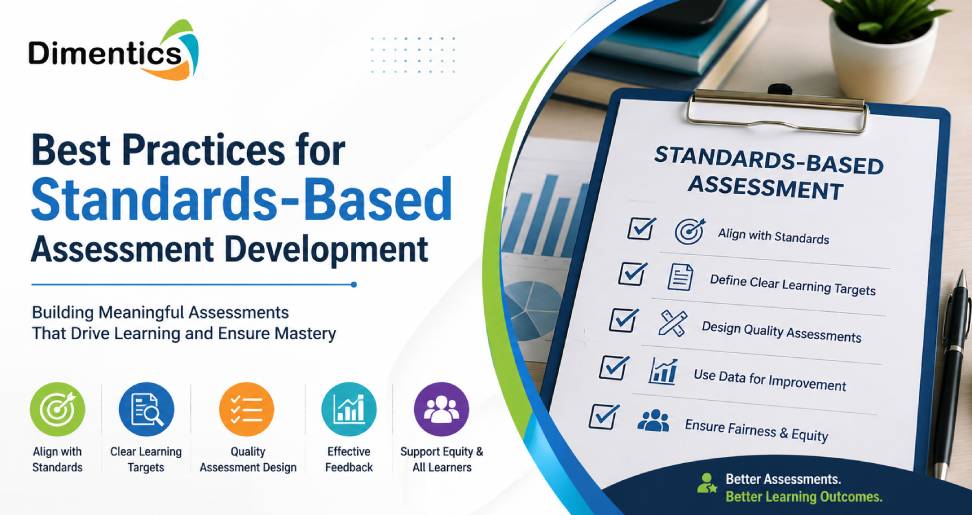
Creating effective assessments is about more than writing good questions. A well-designed assessment should accurately measure what learners are expected to know, understand, and apply. This is where standards-based assessment development becomes essential. By connecting assessments directly to defined academic standards and learning objectives, educators, publishers, and EdTech organizations can create evaluations that are consistent, measurable, and meaningful.
For organizations developing assessments at scale, following established best practices can improve reliability, learner outcomes, and instructional quality. Companies such as Dimentics help educational organizations develop structured, standards-aligned assessments that support modern digital learning environments.
What Is Standards-Based Assessment Development?
Standards-based assessment development is the process of designing quizzes, tests, assignments, and other evaluation tools around specific educational standards and learning outcomes.
Instead of simply testing whether a learner remembers information, standards-based assessments determine whether the learner has achieved clearly defined competencies. This approach helps educators understand where learners are succeeding and where additional instruction may be required.
For publishers and EdTech companies, standards-based assessment development also creates consistency across courses, grade levels, subjects, and learning platforms.
Why Standards-Based Assessments Matter
Traditional assessments can sometimes focus heavily on memorization or isolated knowledge. Standards-based assessments take a more structured approach by connecting every assessment item to an intended learning outcome.
Some important benefits include:
- Clear alignment between curriculum and assessment
- More accurate measurement of learner performance
- Consistent evaluation across different learners and courses
- Better identification of learning gaps
- Improved instructional decision-making
- Easier tracking of progress over time
- Stronger accountability for educational outcomes
When assessments are carefully aligned with standards, educators can gain a clearer picture of whether learners are developing the knowledge and skills expected at their particular level.
1. Start With Clearly Defined Learning Standards
The first step in developing a standards-based assessment is understanding the standards being measured. Assessment developers should identify the relevant grade-level, subject-specific, institutional, or industry standards before creating questions.
Each standard should be broken down into measurable learning objectives. This makes it easier to determine exactly what learners should demonstrate during the assessment.
For example, a broad standard may require students to demonstrate problem-solving skills. The assessment developer can translate this into measurable objectives involving analysis, application, reasoning, and decision-making.
This approach prevents assessments from becoming disconnected from the curriculum.
2. Create a Strong Assessment Blueprint
An assessment blueprint provides a framework for determining what the assessment should measure and how much emphasis should be given to each area.
A useful blueprint may include:
- Learning standards
- Learning objectives
- Content areas
- Question types
- Difficulty levels
- Cognitive skills
- Number of items
- Percentage or weight assigned to each standard
An effective blueprint helps maintain balance and prevents certain topics from being overrepresented.
Dimentics’ Assessment Development Services support structured assessment creation, including question-bank development, competency-based assessment, quality assurance, and alignment with learning objectives.
3. Align Every Question With a Specific Standard
One of the most important best practices for standards-based assessment development is ensuring that every question has a clear purpose.
Assessment items should be mapped to the standard or learning objective they are intended to measure. This process is commonly referred to as item-to-standard alignment.
The alignment should be specific enough that developers can explain why a particular question belongs under a particular standard.
For larger content libraries, Dimentics also provides Standards Alignment Services, including curriculum mapping, standards crosswalking, gap analysis, assessment alignment, and item-to-standard tagging.
4. Use Different Question Types
A standards-based assessment should not depend entirely on multiple-choice questions.
Depending on the learning objective, developers can use:
- Multiple-choice questions
- Short-answer questions
- Extended-response questions
- Case-based questions
- Scenario-based questions
- Simulations
- Performance tasks
- Competency-based assessments
Different question formats allow learners to demonstrate different levels of understanding.
For example, a multiple-choice question may effectively measure knowledge and comprehension, while a scenario-based question may better measure application and problem-solving.
5. Balance Cognitive Difficulty
Effective assessments should include an appropriate range of cognitive demands.
Developers can use frameworks such as Bloom’s Taxonomy to determine whether questions measure remembering, understanding, applying, analyzing, evaluating, or creating.
An assessment containing only basic recall questions may not accurately measure deeper learning. Conversely, an assessment consisting entirely of complex questions may be inappropriate for learners who are still developing foundational knowledge.
A balanced assessment provides opportunities for learners to demonstrate different levels of cognitive ability.
6. Conduct a Standards Coverage and Gap Analysis
After creating an assessment, developers should review whether all required standards have been adequately covered.
This process can reveal:
- Standards with insufficient assessment coverage
- Standards that have too many questions
- Duplicate learning objectives
- Missing competencies
- Questions mapped to the wrong standards
Gap analysis is particularly important when developing large question banks or updating existing educational content.
Dimentics provides standards-focused solutions that can help organizations identify content gaps and strengthen alignment between curriculum, assessments, and educational standards.
7. Prioritize Accessibility and Inclusive Assessment Design
Assessment quality is not only about academic accuracy. Learners should also be able to access and interact with assessments effectively.
Accessible assessment development may involve:
- Clear and readable instructions
- Appropriate text structure
- Keyboard accessibility
- Screen-reader compatibility
- Sufficient color contrast
- Captions and transcripts where appropriate
- Accessible digital question formats
- Avoiding unnecessary visual complexity
Accessibility should be considered during the design stage rather than added as an afterthought.
Dimentics offers Accessibility Services designed to help organizations create accessible digital learning content, including assessments and interactive learning materials.
8. Establish a Rigorous Quality Assurance Process
Quality assurance is essential before assessments are released to learners.
Each item should be reviewed for:
- Accuracy
- Relevance
- Grammar
- Clarity
- Appropriate difficulty
- Correct answer selection
- Distractor quality
- Standard alignment
- Bias and ambiguity
- Formatting and technical issues
A multi-level review process can significantly reduce errors and improve assessment reliability.
Dimentics follows structured quality assurance processes involving content review, curriculum alignment, difficulty balancing, validation, and continuous improvement.
9. Use Data to Improve Assessments
Assessment development should not stop after publication. Performance data can provide valuable information about how individual questions and complete assessments are functioning.
Useful metrics may include:
- Item difficulty
- Learner success rates
- Distractor performance
- Completion rates
- Time spent on questions
- Standard-level performance
- Retake patterns
Analyzing these metrics can help identify questions that are too easy, too difficult, misleading, or poorly aligned.
Organizations can then revise assessment items based on evidence rather than assumptions.
10. Design Assessments for Digital Learning Environments
Modern assessments increasingly need to work across LMS platforms, mobile devices, online learning environments, and customized educational platforms.
Assessment developers should therefore consider responsive design, usability, interoperability, data reporting, and learner experience from the beginning.
For organizations building broader digital learning ecosystems, Dimentics also provides Learning Platform Development Services that support assessments, certifications, analytics, content, and other learning experiences within scalable platforms.
How Dimentics Can Support Standards-Based Assessment Development
Developing a high-quality standards-based assessment system can require significant instructional design, subject-matter expertise, technology, and quality assurance resources.
Dimentics provides assessment and digital learning solutions for educational institutions, publishers, EdTech organizations, and training providers. Its assessment development capabilities cover structured assessment design, question-bank development, competency-based evaluation, digital assessments, and quality assurance.
Its broader education solutions also include curriculum development, instructional content development, standards alignment, accessibility, and learning technology. This allows organizations to approach assessment as part of a complete learning ecosystem rather than as an isolated activity.
Conclusion
The best practices for standards-based assessment development begin with clear standards and measurable learning objectives and continue through blueprinting, item alignment, cognitive balancing, accessibility, quality assurance, and ongoing data analysis.
A strong standards-based assessment should do more than produce a score. It should provide meaningful evidence of learner achievement and help educators, publishers, and learning organizations make better instructional decisions.
By combining sound assessment methodology with technology, analytics, accessibility, and continuous improvement, organizations can build assessment systems that remain accurate, scalable, and relevant. For organizations looking to strengthen these capabilities, Dimentics offers a comprehensive range of assessment and digital learning services designed to support measurable learning outcomes.
Latest Blog
- Curriculum Mapping Services for U.S. Schools and Educational Publishers
- How to Reduce Corporate Training Costs Without Compromising Learning Quality
- How to Create Interactive Digital Textbooks for K–12 Publishers in the USA
- Scenario-Based Learning Development Services for Corporate Training
- How eLearning Solutions Help Businesses Improve Employee Training and Performance