
How EdTech Companies Can Align Learning Content with State Standards
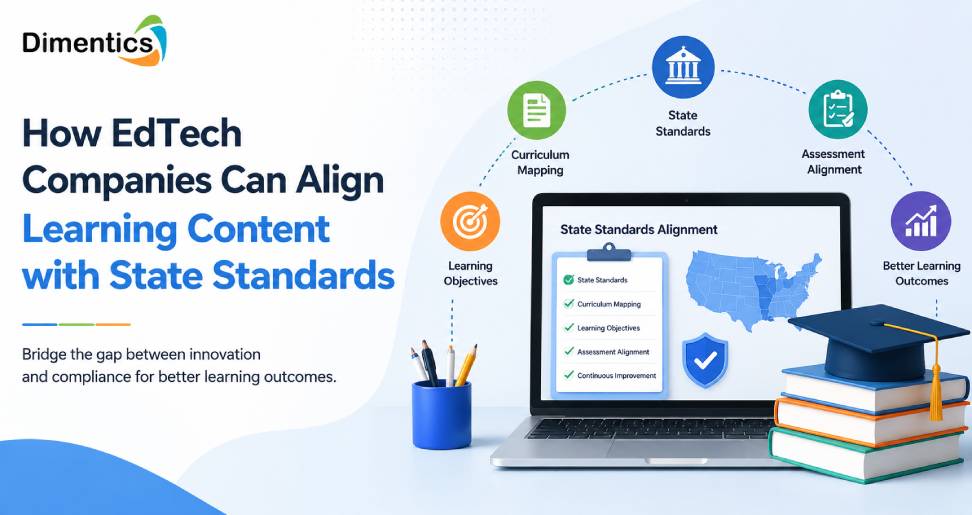
For EdTech companies, creating engaging digital learning content is only one part of the equation. To deliver meaningful educational value, learning materials must also align with the academic standards used by schools, districts, and states. When content reflects state standards accurately, educators can integrate it more confidently into their curriculum, while students receive instruction that supports their expected learning outcomes.
For growing EdTech companies such as Dimentics, standards alignment can become a strategic advantage. By combining instructional design, technology, content development, and assessment expertise, EdTech providers can create learning experiences that are both engaging and academically relevant.
What Does Standards-Aligned Learning Content Mean?
Standards-aligned learning content is educational material intentionally designed to address specific knowledge and skills outlined in state academic standards.
State standards typically define what students should know and be able to do at particular grade levels or stages of education. Depending on the subject, standards may cover areas such as mathematics, science, English language arts, social studies, or other disciplines.
For an EdTech company, alignment means connecting every important part of a learning experience—including lessons, activities, assessments, and learning objectives—to appropriate standards.
Instead of simply creating a lesson about a topic, developers need to determine:
- Which standard does the lesson address?
- What knowledge or skill does the student need to demonstrate?
- What grade level is appropriate?
- How will student understanding be measured?
- Does the assessment accurately reflect the intended standard?
This structured approach helps ensure that digital content supports classroom instruction rather than functioning as disconnected supplementary material.
1. Start With a Detailed Standards Analysis
The first step toward effective alignment is understanding the standards themselves.
EdTech companies should identify the relevant state standards for each subject and grade level they support. Standards should then be broken down into smaller instructional components.
For example, a broad standard may require students to demonstrate a particular mathematical reasoning skill. Instead of treating the entire standard as one learning objective, an instructional design team can identify the prerequisite knowledge, supporting concepts, and measurable skills students need.
This analysis can create a standards map that connects:
State Standard → Learning Objective → Instructional Content → Activity → Assessment
A detailed standards analysis also makes it easier to identify content gaps and unnecessary duplication.
2. Convert Standards Into Measurable Learning Objectives
Standards describe expected outcomes, but EdTech content needs actionable learning objectives.
Learning objectives should clearly communicate what students are expected to accomplish after completing a lesson or learning activity.
For example, instead of using a vague objective such as:
“Students will understand fractions.”
An EdTech company could create a more measurable objective:
“Students will compare two fractions with different denominators using visual models and mathematical reasoning.”
Measurable objectives help instructional designers select appropriate activities and assessments.
This is particularly important when developing digital learning environments because interactive activities should have a clear educational purpose rather than simply providing entertainment.
3. Build a Standards-to-Content Mapping Framework
A standards mapping framework provides a systematic way to connect educational content with curriculum requirements.
Each lesson or learning object can be tagged with information such as:
- State
- Grade level
- Subject
- Standard code
- Standard description
- Learning objective
- Skill
- Difficulty level
- Assessment type
This metadata makes content easier for educators and administrators to search, filter, and integrate into existing curricula.
For an EdTech provider developing large content libraries, structured metadata can also make future updates much more efficient. When standards change, teams can quickly identify affected lessons instead of manually reviewing an entire library.
4. Use Instructional Design Principles
Standards alignment should not result in content that feels rigid or overly academic. Students still need engaging learning experiences.
This is where professional instructional design becomes essential.
Dimentics can support EdTech organizations through Instructional Design Services, helping transform curriculum requirements into structured and learner-focused educational experiences.
Effective instructional design can incorporate:
- Interactive learning activities
- Scenario-based learning
- Simulations
- Multimedia
- Microlearning
- Practice exercises
- Knowledge checks
- Formative assessments
- Adaptive learning experiences
The objective is to ensure that technology enhances learning while remaining connected to the intended academic outcome.
5. Develop Assessments That Match the Standards
A common mistake in digital education is creating assessments that test information rather than the actual skill described by a standard.
If a standard requires students to analyze, evaluate, compare, or apply information, a simple recall-based multiple-choice question may not adequately measure achievement.
EdTech companies should therefore ensure that assessments match the cognitive demand of the standard.
For example:
Standard: Students analyze evidence to support a conclusion.
Weak assessment:
“What is the definition of evidence?”
Better assessment:
“Review the evidence provided and select the conclusion that is best supported by it.”
The second question measures application of the intended skill rather than simple memorization.
Dimentics’ Assessment Development Services can help organizations design assessments that connect learning objectives, standards, and measurable student performance.
6. Consider Microlearning for Standards-Based Education
Not every learning objective requires a lengthy lesson.
Microlearning can break complex standards into smaller, manageable learning experiences. A single digital module might focus on one concept, skill, or prerequisite knowledge area.
This approach can be particularly useful when students need targeted practice or remediation.
A microlearning sequence might include:
- A short instructional explanation
- An interactive example
- Guided practice
- Independent practice
- A short assessment
- Feedback and remediation
Dimentics can help organizations create structured digital learning experiences through its Microlearning Development Services, making standards-based content easier to consume and revisit.
7. Incorporate Accessibility Into Content Development
Standards alignment is important, but educational content must also be accessible to diverse learners.
EdTech companies should consider accessibility throughout the content development process rather than treating it as a final technical check.
Depending on the learning environment, this may involve:
- Captions for videos
- Transcripts for audio
- Accessible navigation
- Alternative text for meaningful images
- Keyboard accessibility
- Readable typography
- Appropriate color contrast
- Clear instructions
- Screen-reader compatibility
Accessible content allows more students to benefit from standards-aligned learning experiences.
8. Use Technology to Make Standards Alignment Scalable
For EdTech companies with extensive content libraries, manually managing standards alignment can become difficult.
Technology can help streamline the process.
Learning platforms and content management systems can use metadata, tagging, dashboards, and analytics to track standards coverage. Content teams can also use structured databases to connect individual learning resources with multiple standards where appropriate.
Automation and AI can assist with tasks such as:
- Identifying potential standards matches
- Organizing content metadata
- Detecting duplicate content
- Finding content gaps
- Supporting content reviews
- Generating draft assessment items
However, automated recommendations should be reviewed by qualified curriculum and instructional experts. Standards alignment requires educational judgment, and technology should support—not replace—that expertise.
9. Conduct Expert Review and Validation
Before publishing standards-aligned content, EdTech companies should conduct a thorough quality review.
A review process may involve curriculum specialists, instructional designers, subject-matter experts, educators, and assessment specialists.
They can evaluate whether:
- The correct standard has been selected
- The learning objective accurately reflects the standard
- The instructional content teaches the required skill
- Activities provide sufficient practice
- Assessments measure the intended outcome
- The difficulty is appropriate for the grade level
- Content is accurate and inclusive
- Accessibility requirements have been considered
This additional review can significantly improve the reliability of an EdTech product.
10. Keep Content Updated as Standards Change
State standards are not necessarily static. Curriculum frameworks, expectations, assessment approaches, and educational requirements can change over time.
Therefore, standards alignment should be treated as an ongoing process.
EdTech companies should maintain a standards management workflow that records:
- Current standards
- Previous standards
- Content mapped to each standard
- Date of last review
- Content requiring revision
- Assessment changes
- Version history
This makes it easier to update learning products when states introduce new academic expectations.
Why Standards Alignment Matters for EdTech Companies
Strong standards alignment benefits more than just students.
For educators, it makes digital resources easier to integrate into lesson plans and curriculum frameworks.
For school administrators, it provides greater confidence that technology investments support instructional goals.
For students, it creates a clearer connection between digital activities and classroom learning.
For EdTech companies, it can strengthen product credibility, improve adoption, and create stronger relationships with educational institutions.
A standards-aligned product can therefore become more than a collection of digital lessons—it can become a dependable instructional resource.
How Dimentics Can Help EdTech Companies
Developing high-quality standards-aligned learning content requires a combination of educational expertise, instructional design, technology, and quality assurance.
Dimentics works with organizations to develop effective digital learning experiences that can support modern educational and training requirements.
Its Learning Content Development Services can help transform curriculum requirements and subject-matter expertise into structured digital learning materials.
Organizations can also leverage Instructional Design Services to create learner-centered course structures, Microlearning Development Services for concise skill-focused learning experiences, and Assessment Development Services to build assessments connected to measurable learning outcomes.
By bringing these capabilities together, Dimentics can support EdTech companies throughout the content development lifecycle—from planning and instructional design to development, assessment, and quality improvement.
Final Thoughts
Aligning learning content with state standards is not simply about adding standard codes to digital lessons. It requires a structured process that connects curriculum expectations with learning objectives, instructional activities, assessments, accessibility, and ongoing content management.
EdTech companies that invest in meaningful standards alignment can create products that are easier for educators to adopt and more valuable for students.
With the right combination of instructional expertise and technology, organizations can build digital learning experiences that are engaging, measurable, scalable, and aligned with real educational needs.
For EdTech companies looking to strengthen their learning content strategy, Dimentics offers the expertise and development capabilities needed to turn educational requirements into effective digital learning experiences.
Latest Blog
- Curriculum Mapping Services for U.S. Schools and Educational Publishers
- How to Reduce Corporate Training Costs Without Compromising Learning Quality
- How to Create Interactive Digital Textbooks for K–12 Publishers in the USA
- Scenario-Based Learning Development Services for Corporate Training
- How eLearning Solutions Help Businesses Improve Employee Training and Performance