
Curriculum Alignment vs. Standards Alignment: Which Does Your Education Business Need?
For education publishers, EdTech companies, schools, and learning businesses, alignment is more than an academic exercise. It directly affects the quality of learning content, assessment effectiveness, adoption opportunities, and learner outcomes. But two terms are often used interchangeably: curriculum alignment and standards alignment.
Although they are closely connected, they serve different purposes.
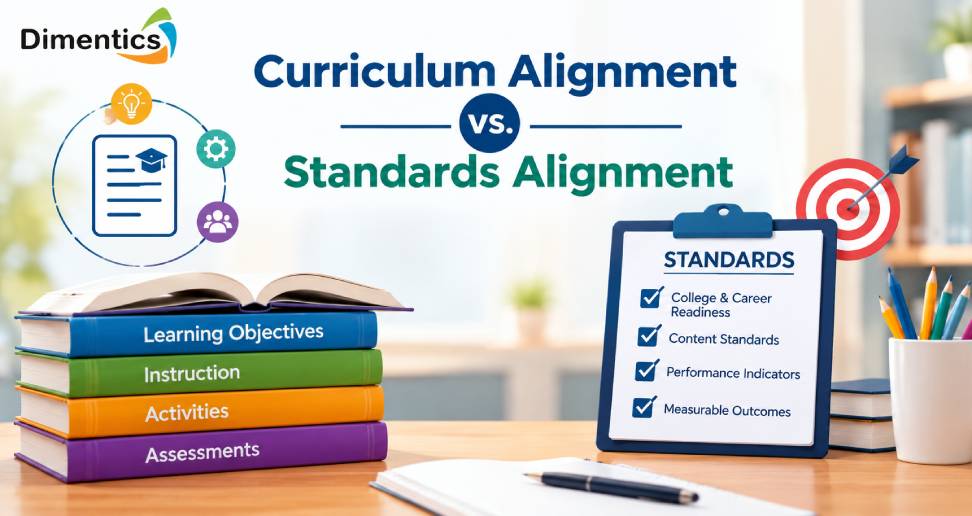
Curriculum alignment focuses on ensuring that learning objectives, instructional materials, teaching activities, and assessments work together as a coherent learning journey. Standards alignment, meanwhile, connects educational content and assessments to specific academic standards, frameworks, or competencies.
So, which does your education business need?
The answer depends on your goals, target market, content structure, and adoption requirements. Understanding the difference can help you make better decisions about content development and educational strategy.
What Is Curriculum Alignment?
Curriculum alignment is the process of making sure different components of a learning program work together logically.
A well-aligned curriculum connects:
- Learning objectives
- Course content
- Instructional activities
- Learning resources
- Assessments
- Expected learner outcomes
For example, if a course teaches students how to analyze data, the learning activities should give them opportunities to practice data analysis, while assessments should actually measure that capability.
Curriculum alignment therefore creates consistency and coherence across the entire learning experience.
For education businesses developing complete courses, training programs, or academic pathways, this is particularly important. Dimentics’ Curriculum Design and Instructional Design Services support structured, outcome-driven learning programs by connecting objectives, content, assessments, and delivery methods.
What Is Standards Alignment?
Standards alignment is more externally focused.
Instead of asking only whether your course components work together, standards alignment asks:
Does our educational content address the specific knowledge and skills required by an established academic standard?
Depending on the market, those standards could include frameworks such as:
- Common Core State Standards (CCSS)
- Next Generation Science Standards (NGSS)
- TEKS
- Florida B.E.S.T.
- C3 Framework
- ISTE Standards
- State-specific academic standards
For publishers and EdTech companies selling into the K-12 market, standards alignment can be especially important because schools and districts may require evidence that instructional materials address particular standards before considering them for adoption.
Dimentics provides Standards Alignment Services that cover standards correlation, curriculum mapping, standards crosswalking, gap analysis, assessment alignment, and related quality-review services.
Curriculum Alignment vs. Standards Alignment: The Key Difference
The simplest way to understand the distinction is:
Curriculum alignment asks, “Do all parts of our learning program work together?”
Standards alignment asks, “Does our learning content meet the requirements of the applicable academic standards?”
They overlap, but neither completely replaces the other.
Consider an EdTech company developing a Grade 6 mathematics platform.
The company may first establish learning objectives, lessons, activities, and assessments that form a logical curriculum. That is curriculum alignment.
It may then map those lessons and assessments to the relevant state mathematics standards. That is standards alignment.
The strongest education products often require both.
When Does Your Business Need Curriculum Alignment?
Curriculum alignment should be a priority if your organization is:
Developing a New Course
If you are creating a course from scratch, alignment can prevent disconnected lessons and assessments. Every module should contribute to clearly defined learning outcomes.
Updating an Existing Curriculum
Older courses can develop inconsistencies over time. New lessons may be added without updating assessments or learning objectives. A curriculum review can identify these weaknesses.
Dimentics offers Curriculum Review and Evaluation Services to help organizations assess and optimize existing curriculum structures.
Building Workforce Training
Corporate learning programs also benefit from curriculum alignment. Training should connect business goals, employee competencies, learning activities, and performance measurement.
Creating Higher Education Programs
Universities and online education providers need coherent course structures that connect learning outcomes, instructional resources, assessment strategies, and technology.
When Does Your Business Need Standards Alignment?
Standards alignment becomes particularly important when your content needs to satisfy external academic frameworks.
Selling K-12 Content
Publishers and EdTech companies entering US K-12 markets may need to demonstrate alignment with specific state or national standards.
Preparing for District or State Adoption
When educational products are reviewed by districts or adoption committees, clearly documented standards correlation can help demonstrate content coverage and instructional relevance.
Expanding Across States
A curriculum developed for one state may not automatically satisfy another state’s standards. Standards crosswalking can help identify similarities, differences, and content gaps.
Aligning Assessments
Assessments should measure the knowledge and skills represented by the standards. Dimentics provides Assessment Development Services that can support standards-aligned quizzes, tests, and competency-based assessments.
Why Combining Both Approaches Is Often Better
Choosing between curriculum alignment and standards alignment can create a false dilemma.
For many education businesses, the better approach is to combine them.
Imagine a publisher creates an excellent science curriculum. The lessons are logically sequenced, the learning objectives are clear, and the assessments measure what students learned.
However, if the content does not clearly address the standards required by the target market, the publisher may struggle during procurement or adoption.
The opposite can also happen.
A product might be mapped extensively to standards but still provide a fragmented learner experience. Students could encounter disconnected activities, poorly sequenced concepts, or assessments that do not adequately reinforce instruction.
Standards alignment provides external relevance. Curriculum alignment provides internal coherence.
Together, they create stronger educational content.
How Dimentics Can Support Your Alignment Strategy
For organizations that need both instructional quality and standards compliance, Dimentics provides an integrated approach.
Its services cover Curriculum Development, Curriculum Mapping Services, Standards Correlation and Content Alignment, Assessment Development, and Accessibility Compliance Services.
Dimentics also supports digital learning development, including Custom eLearning Development Services and Learning Platform Development Services, allowing education organizations to connect aligned instructional content with modern digital delivery.
This integrated model can be particularly valuable for publishers and EdTech businesses that need to manage content development, curriculum strategy, standards mapping, assessments, accessibility, and technology as connected parts of one learning ecosystem.
A Practical Framework for Choosing What You Need
Ask your organization these five questions:
1. Are we creating or restructuring a complete learning program?
If yes, curriculum alignment should be a priority.
2. Are we selling content into a standards-driven education market?
If yes, standards alignment is essential.
3. Are our assessments directly connected to learning objectives and standards?
If not, assessment alignment should be reviewed.
4. Are we expanding into different states or education markets?
If yes, standards crosswalking and gap analysis can help.
5. Does our digital content need to meet accessibility requirements as well?
If yes, alignment should be considered alongside accessibility and compliance from the beginning.
Final Thoughts
Curriculum alignment and standards alignment are not competing strategies. They solve different problems.
Curriculum alignment creates a coherent learning experience. Standards alignment demonstrates that the experience addresses recognized academic expectations.
For many education businesses, particularly K-12 publishers and EdTech companies, combining both approaches is the strongest strategy.
Start with your learning goals and curriculum structure. Then map the appropriate content, activities, and assessments to the standards required by your target market. Finally, review the content for quality, accessibility, consistency, and measurable outcomes.
With the right strategy and specialist support, alignment can become more than a compliance task—it can become a competitive advantage.
For organizations looking to strengthen their curriculum, standards mapping, assessments, and digital learning ecosystem, Dimentics offers end-to-end learning design and EdTech services designed to support scalable, standards-aligned educational experiences.
Latest Blog
- Curriculum Alignment vs. Standards Alignment: Which Does Your Education Business Need?
- How to Choose the Right eLearning Content Development Company for Your Organization
- A Complete Guide to Standards Correlation for K–12 Publishers
- How to Plan a Successful Custom eLearning Project
- How AI Is Transforming Standards Alignment