
White-Label eLearning Production: How Agencies and Training Providers Should Vet an Overflow Partner
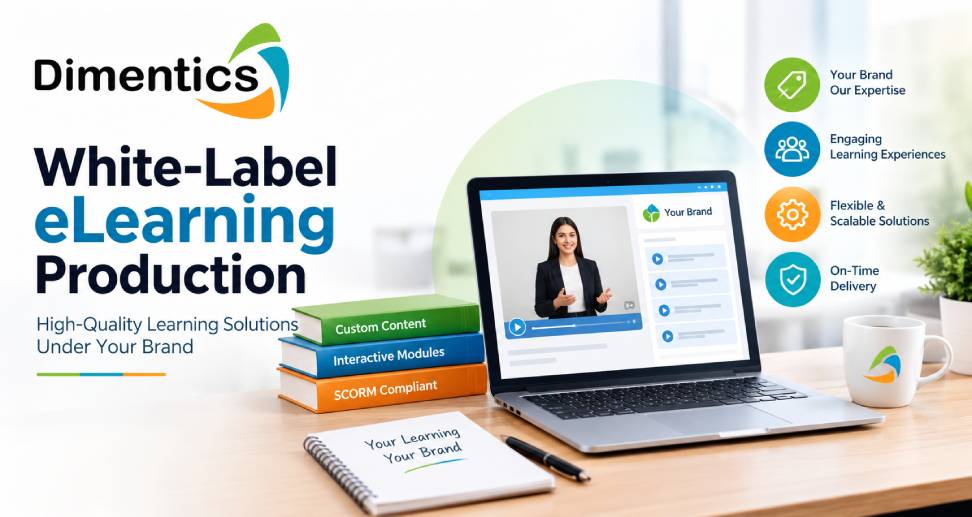
As demand for digital learning continues to grow, eLearning agencies and corporate training providers often face a common challenge: delivering high-quality learning experiences while managing tight deadlines, limited resources, and increasing client expectations. When several projects arrive simultaneously, internal teams may struggle to maintain production speed without compromising quality.
White-label eLearning production offers a practical solution. It allows agencies, consultants, and training providers to outsource course development to a specialist partner while delivering the finished work under their own brand. However, choosing the wrong partner can lead to missed deadlines, inconsistent instructional quality, communication problems, and dissatisfied clients.
Therefore, businesses should carefully evaluate potential providers before entering a partnership. Understanding what to assess can help organizations select a reliable production partner that supports long-term growth. Companies seeking professional support can also explore Dimentics’ eLearning content development services to help meet their digital learning production requirements.
What Is White-Label eLearning Production?
White-label eLearning production is a business arrangement in which a specialist provider develops digital learning materials for another organization without prominently displaying its own brand. The agency or training provider then presents the completed deliverables to its clients under its own identity.
Depending on the agreement, these services may include instructional design, storyboard development, multimedia production, interactive learning activities, assessments, course authoring, and learning management system (LMS) integration.
For agencies, this model creates additional production capacity without requiring a permanent increase in staffing. Training providers can also expand their service offerings, manage larger contracts, and respond to client requirements more efficiently.
However, successful outsourcing depends on more than finding a company that can produce courses. The right partner must understand your workflow, maintain your quality standards, protect confidential information, and work seamlessly behind the scenes.
1. Evaluate Instructional Design and Production Expertise
The first step is to examine the partner’s technical capabilities and instructional design experience. A visually attractive course is not necessarily an effective learning experience. Good eLearning should communicate information clearly, support learning objectives, and encourage learners to apply what they have learned.
Ask prospective partners about their experience with different content formats, including interactive modules, scenario-based learning, software simulations, assessments, and microlearning.
Review sample projects to understand how they structure content, organize learning activities, and present complex information. If your agency specializes in corporate training, look for experience creating professional development courses, compliance training, employee onboarding, or product education.
You should also evaluate the provider’s ability to work with popular authoring tools and accommodate your preferred publishing formats.
Businesses looking to expand their production capabilities can consider Dimentics’ custom eLearning development services for support with creating engaging, structured, and audience-focused digital learning content.
2. Check White-Label Flexibility and Branding Control
A reliable overflow partner must understand that your agency owns the client relationship. The partner should work according to your branding requirements and avoid presenting itself as the primary service provider unless explicitly agreed.
Before signing a contract, clarify how branding will be handled across course interfaces, opening and closing screens, documentation, templates, and communication materials.
Determine whether the partner can follow your existing design system, visual guidelines, terminology, and instructional standards. Ask whether it can work with your templates or create new materials that match your client’s specifications.
It is equally important to establish clear communication boundaries. Confirm who will attend client meetings, respond to questions, manage revisions, and provide project updates.
A well-structured white-label arrangement should allow your agency to maintain control over the client experience while benefiting from specialist production expertise.
3. Assess Scalability and Overflow Capacity
Overflow support is most valuable when project demand fluctuates. Your partner should be able to accommodate additional work during busy periods without creating unnecessary delays or reducing production quality.
Ask how the provider manages multiple projects, allocates resources, and handles urgent requests. Find out whether it has a dedicated production team, established workflows, and backup arrangements when key team members are unavailable.
You should also assess its ability to handle projects of different sizes. A partner suitable for producing a single training module may not have the capacity to manage a large course library or several simultaneous client engagements.
Request examples of how the provider has handled increased workloads, compressed timelines, or changing project requirements.
Rather than relying on broad promises about scalability, begin with a small paid pilot project. This allows you to assess turnaround times, responsiveness, production consistency, and the team’s ability to follow instructions before committing to larger engagements.
4. Establish Quality Assurance and Review Processes
Quality assurance is essential when outsourced work represents your brand. Errors in content, navigation, assessments, accessibility, or technical functionality can damage client confidence and create additional costs.
Ask prospective partners to explain their quality assurance process. A dependable workflow should include content reviews, instructional design checks, visual consistency assessments, functionality testing, and final approval before delivery.
For interactive courses, testing should cover navigation, buttons, quizzes, feedback, media playback, and completion tracking. If the project requires LMS compatibility, clarify whether SCORM or xAPI requirements apply and how those requirements will be tested.
Accessibility should also be part of the discussion. Depending on the audience and project scope, courses may require captions, transcripts, keyboard navigation, accessible interactions, and appropriate contrast.
Consider partners that offer eLearning accessibility support or can incorporate accessibility requirements into their production workflow.
Define measurable acceptance criteria before work begins. These may include delivery milestones, error thresholds, revision limits, technical requirements, and approval responsibilities.
5. Review Communication, Project Management, and Turnaround Times
Even a technically skilled provider can become difficult to work with if communication is inconsistent. Agencies need clear updates, predictable timelines, and quick responses when client requirements change.
During the evaluation process, ask how projects are managed and tracked. Determine whether the provider uses project management platforms, milestone-based delivery, shared documentation, or regular progress meetings.
A well-organized workflow should identify responsibilities for every stage, from receiving source materials to delivering the final course package.
Clarify expected response times, escalation procedures, and how urgent changes will be handled. You should also establish a process for managing feedback from multiple stakeholders without creating conflicting instructions.
Pay attention to communication during the initial discussions. If a prospective partner struggles to answer straightforward questions, clarify deliverables, or meet agreed deadlines before the contract begins, these issues may become more serious during active projects.
6. Verify Confidentiality, Intellectual Property, and Security
White-label partnerships often involve unpublished course content, client information, internal training materials, and proprietary business processes. Protecting these assets should be a priority.
Before sharing sensitive files, establish confidentiality requirements through an appropriate non-disclosure agreement and a written service contract.
Clarify ownership of source files, storyboards, graphics, scripts, audio, animations, and final course packages. The agreement should explain whether your agency or client receives ownership, what usage rights apply, and whether third-party assets introduce licensing restrictions.
Ask how the partner controls access to project files, stores confidential materials, manages user permissions, and handles data retention or deletion.
If projects involve regulated industries or sensitive employee information, evaluate whether the provider can meet the applicable security and contractual requirements.
Do not assume that confidentiality is guaranteed simply because the arrangement is described as white-label. Responsibilities and permissions should be documented explicitly.
7. Compare Pricing, Contracts, and Revision Policies
Price matters, but the lowest quotation does not always provide the best value. An inexpensive production service can become costly if it requires repeated corrections, creates technical issues, or misses delivery dates.
Request a detailed breakdown of pricing. Understand what is included in the quoted fee, such as instructional design, multimedia assets, voiceovers, quality assurance, source files, and publishing support.
Ask how additional revisions, scope changes, rush projects, and ongoing maintenance are charged. Confirm whether pricing is based on project complexity, course duration, screen count, or another method.
Review the contract for payment milestones, delivery commitments, termination conditions, confidentiality, intellectual property, and dispute resolution.
A transparent pricing model helps agencies prepare accurate client quotations and protect their margins while maintaining consistent service quality.
8. Start With a Pilot Project Before Scaling
A pilot project provides practical evidence of a partner’s capabilities. Instead of evaluating a provider entirely through presentations and promises, test its performance against a real business requirement.
Choose a manageable project that reflects your typical workflow. Provide a clear brief, learning objectives, branding guidelines, technical specifications, and an agreed delivery schedule.
Evaluate the final output against several criteria: instructional quality, design consistency, responsiveness, technical performance, deadline adherence, and revision management.
Gather feedback from internal stakeholders before assigning additional work. Document what worked well and what needs improvement, then incorporate those findings into the partnership agreement.
Once the partner demonstrates reliable performance, gradually increase the project volume and complexity.
Why Dimentics Can Be Part of Your eLearning Production Evaluation
Agencies and training providers seeking external production support can explore Dimentics‘ eLearning content development services as part of their partner evaluation process.
When assessing Dimentics for a white-label or overflow engagement, discuss your expected production volume, preferred authoring tools, branding requirements, accessibility needs, turnaround expectations, and ownership terms. Request relevant work samples and clarify which services can be delivered under your agency’s brand.
You can also explore whether custom eLearning development, interactive learning content, and training material development align with your current project requirements.
As with any potential partner, confirm service scope, capacity, quality assurance procedures, pricing, and contractual arrangements before proceeding. A clear understanding of these details helps establish realistic expectations and supports a productive working relationship.
Conclusion
White-label eLearning production can help agencies and training providers expand capacity, accept larger projects, and deliver digital learning solutions without building every capability in-house. However, the benefits depend on selecting a partner that combines instructional design expertise, reliable production workflows, strong communication, and appropriate security practices.
Before making a decision, assess technical capabilities, branding flexibility, scalability, quality assurance, intellectual property protection, and pricing transparency. A carefully designed pilot project can reveal whether the provider meets your standards in real working conditions.
By applying these evaluation criteria, agencies can build dependable partnerships that support sustainable growth and protect client relationships. Exploring suitable providers, including Dimentics, can be a useful step toward creating a more flexible and efficient eLearning production process.
Latest Blog
- Custom Employee Onboarding Training Development: A Guide for U.S. HR Teams
- How to Convert Instructor-Led Training into eLearning for U.S. Companies
- Hire eLearning Developers in the USA: Skills, Costs, and Project Considerations
- White-Label eLearning Production: How Agencies and Training Providers Should Vet an Overflow Partner
- Outsource Instructional Design Services in the USA: A Complete Guide for L&D Teams