
A Complete Guide to Standards Correlation for K–12 Publishers
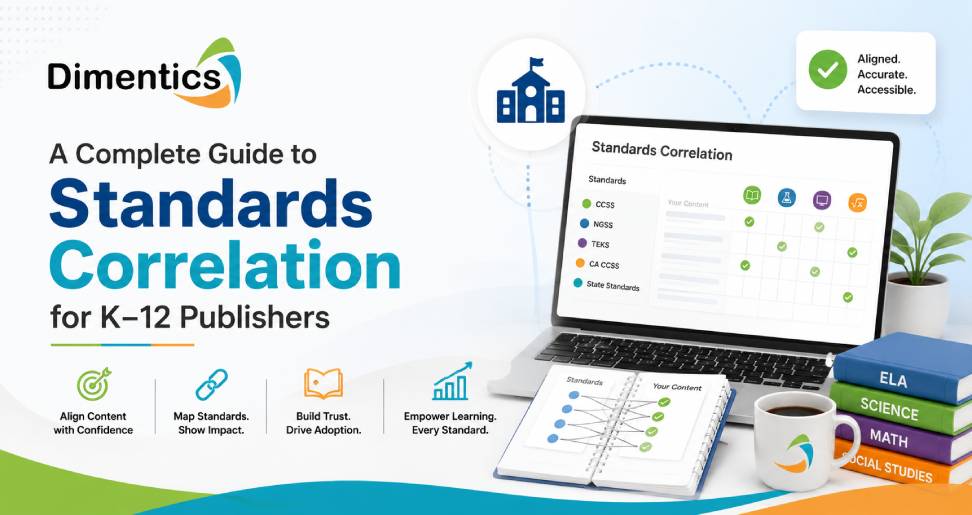
For K–12 publishers, creating high-quality educational content is only part of the challenge. Modern schools and educators also expect instructional materials to align with the standards they are required to teach. This is where standards correlation becomes essential.
Standards correlation is the process of examining educational content and mapping it against specific academic standards to determine where and how the content addresses required learning objectives. A well-designed correlation gives publishers, educators, curriculum leaders, and school districts confidence that instructional resources support classroom requirements.
With changing curricula, evolving state standards, and growing demand for personalized learning, understanding how standards correlation works can help K–12 publishers create more useful, discoverable, and instructionally relevant products.
What Is Standards Correlation?
Standards correlation involves systematically matching learning content to educational standards.
A publisher may have thousands of lessons, activities, assessments, videos, or digital resources. Each resource needs to be reviewed to determine which standards it supports and to what extent.
For example, a mathematics lesson covering fractions may correlate with a particular grade-level mathematics standard addressing fraction operations. A science activity about ecosystems could be connected to standards covering relationships between organisms and their environments.
The goal is not simply to place a standards code next to a lesson. Effective correlation demonstrates a meaningful relationship between the content, the learning objective, and the expectations defined by the standard.
Why Standards Correlation Matters for K–12 Publishers
Standards alignment can influence how educational products are evaluated, purchased, implemented, and used.
1. Supports Curriculum Alignment
Teachers need instructional materials that complement the curriculum they are already required to deliver. Standards correlation allows educators to quickly determine whether a resource supports particular learning expectations.
This makes it easier for schools to integrate publisher content into existing instructional plans.
2. Improves Content Discoverability
A large educational content library can be difficult to navigate. Standards metadata provides another way for educators to find relevant resources.
Instead of searching only by topic or grade level, users can search for content associated with a specific standard or learning objective.
3. Helps Publishers Meet Adoption Requirements
Many school districts and education organizations evaluate instructional materials based on their alignment with applicable standards. A clear correlation report can therefore become an important component of a publisher’s curriculum adoption strategy.
Publishers that demonstrate strong alignment can make it easier for curriculum teams to evaluate their resources.
4. Strengthens Digital Learning Products
Digital curriculum platforms increasingly depend on structured metadata. Standards information can be integrated into content management systems, learning platforms, assessment systems, and search tools.
This makes standards correlation particularly valuable for publishers developing modern digital learning experiences.
The Standards Correlation Process
Although the exact workflow differs between publishers, a structured process usually includes several important stages.
Step 1: Identify the Applicable Standards
The first step is determining which standards framework applies to the content.
Depending on the target market, publishers may need to consider state standards, national frameworks, subject-specific standards, or district-level requirements.
It is important to verify the correct grade, subject, strand, domain, and standard identifiers before beginning the correlation process.
Step 2: Analyze the Instructional Content
The next step is a detailed review of the material.
Content specialists examine lessons, learning objectives, activities, assessments, teacher resources, and supporting materials. They determine what students are actually expected to know or demonstrate after engaging with the content.
This distinction is important because a lesson can mention a concept without genuinely teaching the knowledge or skill described by a standard.
Step 3: Map Content to Standards
Once the instructional content has been analyzed, appropriate standards are mapped to individual resources.
A strong mapping considers factors such as:
- Grade-level appropriateness
- Subject area
- Knowledge and skills addressed
- Depth of learning
- Learning objectives
- Assessment evidence
- Instructional context
The correlation should be based on meaningful instructional evidence rather than keyword matching alone.
Step 4: Validate the Correlations
Quality assurance is one of the most important stages of the process.
A second reviewer or standards expert can evaluate whether each correlation is accurate and defensible. This helps identify weak matches, incorrect codes, missing standards, and overly broad correlations.
Independent validation is especially useful when publishers are preparing materials for large-scale curriculum adoption.
Step 5: Organize the Results
After validation, correlation information needs to be presented in a format that educators and curriculum teams can easily understand.
A correlation document might include:
| Content Resource | Grade | Standard | Evidence of Alignment |
|---|---|---|---|
| Lesson 1 | Grade 5 | Standard A | Students analyze fractions |
| Lesson 2 | Grade 5 | Standard B | Students solve fraction problems |
| Activity 3 | Grade 5 | Standard C | Students explain mathematical reasoning |
Digital products can also store these relationships as structured metadata, allowing users to filter and discover resources more efficiently.
Common Challenges in Standards Correlation
Standards correlation can become complicated when publishers manage large content libraries.
One common challenge is changing standards. State and district requirements can be revised, meaning previously correlated content may require review.
Another challenge is subjectivity. Two reviewers may interpret a lesson differently unless the publisher establishes clear correlation criteria.
Scale is another major consideration. Manually reviewing thousands of resources can consume substantial time and internal resources.
Finally, publishers must avoid false alignment. Simply mentioning vocabulary associated with a standard does not necessarily mean that the content addresses the standard adequately.
How Technology Can Improve Standards Correlation
Technology can significantly streamline the correlation workflow.
Structured content systems can store standards information alongside individual lessons and resources. Search and filtering tools can then help users locate materials according to grade, subject, standard, or learning objective.
Publishers can also explore AI-assisted content analysis to identify potential standards matches. However, automated recommendations should ideally be reviewed by qualified curriculum and standards experts before being treated as final correlations.
For organizations developing sophisticated educational platforms, LMS development services can help create systems capable of managing standards metadata, curriculum resources, assessments, and learner information within an integrated environment.
Similarly, learning animation services can support engaging digital learning resources while standards metadata helps ensure that those resources are connected to appropriate instructional objectives.
Best Practices for K–12 Publishers
To create reliable standards correlations, publishers should establish a consistent methodology.
Start by developing clear criteria for what constitutes an acceptable alignment. Make sure reviewers understand the difference between a direct match, partial match, and unsupported connection.
Keep standards information organized and version-controlled so that updates can be tracked efficiently.
It is also beneficial to maintain detailed documentation explaining why each resource was correlated with a particular standard. This creates greater transparency during curriculum reviews and adoption processes.
Publishers should also consider accessibility and usability when developing digital resources. Combining standards alignment with accessible learning content can help ensure that instructional materials serve a broader range of learners.
The Future of Standards Correlation
As K–12 education becomes increasingly digital, standards correlation will become more closely connected with content management, assessment, personalization, and analytics.
Publishers will need more than static correlation documents. They will increasingly require structured systems that allow standards relationships to be updated, searched, analyzed, and displayed dynamically.
This creates opportunities for education technology providers and curriculum developers to build smarter content ecosystems. With the right combination of standards expertise, technology, quality assurance, and instructional design, publishers can make their resources more valuable to educators and easier for schools to evaluate.
Conclusion
Standards correlation is a critical part of modern K–12 publishing. It helps connect educational resources with curriculum expectations while making content easier for educators to discover, evaluate, and implement.
A successful correlation strategy requires more than matching content with standards codes. It involves careful content analysis, knowledgeable reviewers, consistent methodology, validation, documentation, and ongoing maintenance.
For publishers managing increasingly large digital libraries, combining standards correlation with technology can create a scalable and efficient approach to curriculum alignment. By investing in accurate correlations and well-structured educational content, K–12 publishers can strengthen their products and provide educators with greater confidence in the resources they use.
Whether a publisher is updating an existing curriculum library or building a new digital learning platform, standards correlation should be treated as an essential component of the overall content strategy.
Latest Blog
- Curriculum Mapping Services for U.S. Schools and Educational Publishers
- How to Reduce Corporate Training Costs Without Compromising Learning Quality
- How to Create Interactive Digital Textbooks for K–12 Publishers in the USA
- Scenario-Based Learning Development Services for Corporate Training
- How eLearning Solutions Help Businesses Improve Employee Training and Performance