
How to Choose an Accessibility Remediation Partner for K-12 Publishers
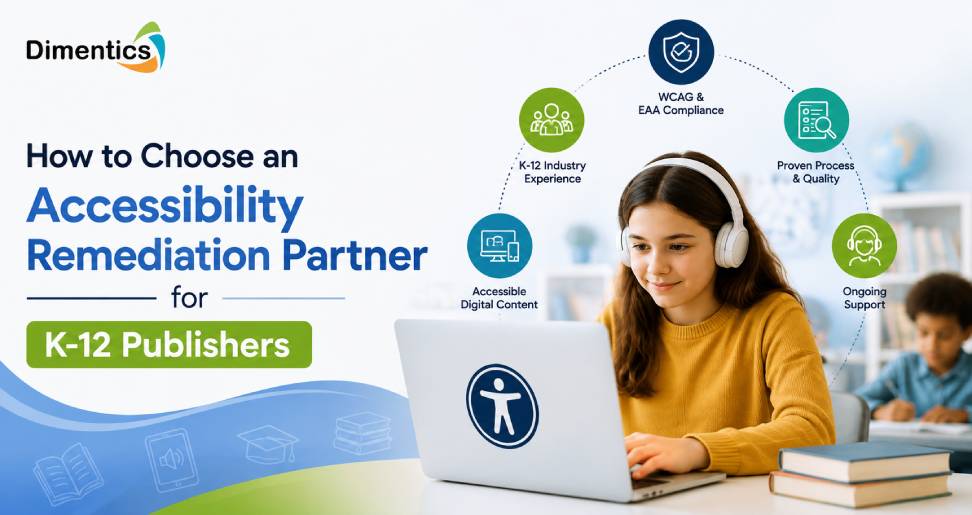
Digital accessibility is becoming an essential part of modern K-12 publishing. Schools, teachers, parents, and students increasingly rely on digital textbooks, learning platforms, PDFs, EPUBs, websites, assessments, and multimedia resources. If these materials are difficult to navigate or use with assistive technologies, students with disabilities can face unnecessary barriers to learning.
For K-12 publishers, accessibility remediation is therefore more than a compliance exercise. It is an opportunity to create more inclusive educational experiences while improving the quality and usability of digital content.
Choosing the right accessibility remediation partner is an important decision. The right provider should understand publishing workflows, educational content, accessibility standards, assistive technologies, and the practical challenges involved in remediating large content libraries.
Why Accessibility Remediation Matters for K-12 Publishers
Educational publishers often manage thousands of digital assets across multiple formats. These may include HTML content, PDFs, EPUBs, interactive lessons, assessments, videos, presentations, and learning-management-system resources.
Accessibility issues can appear throughout these materials. Common examples include missing alternative text, incorrect heading structures, insufficient color contrast, inaccessible tables, poor keyboard navigation, unlabeled form fields, and documents that do not work correctly with screen readers.
Section 508 guidance emphasizes accessibility throughout the content lifecycle, including creation, testing, publication, and ongoing remediation. It also recommends using accessibility testing tools alongside manual review.
For publishers serving U.S. educational organizations, understanding applicable accessibility requirements and customer expectations is particularly important.
1. Look for K-12 Publishing Experience
Accessibility remediation is not the same for every industry. A provider that primarily works on corporate websites may not understand the complexities of educational publishing.
Ask potential partners whether they have experience with:
- Digital textbooks
- Educational PDFs
- EPUB publications
- Online learning platforms
- Assessments and worksheets
- Interactive educational content
- Teacher resources
- Student-facing materials
- Multimedia learning resources
A strong partner should understand that educational content often contains complex diagrams, mathematical notation, charts, tables, exercises, page references, and interactive elements.
The European Union’s accessible publishing guidance, for example, covers formats including HTML, PDF, EPUB, Word, and InDesign, demonstrating how accessibility requirements can extend across an entire publishing workflow.
2. Verify Their Knowledge of Accessibility Standards
Before selecting a remediation partner, establish exactly which standards they work with.
Depending on your target markets and products, you may need expertise in WCAG, Section 508, PDF accessibility, EPUB Accessibility, and other relevant requirements.
Don’t simply ask whether a company “does accessibility.” Ask them to explain:
- Which WCAG version they use
- Which conformance level they target
- How they approach PDF remediation
- How they evaluate EPUB accessibility
- How they test websites and learning platforms
- How they document accessibility issues
- How they validate remediated content
For example, Section 508 guidance identifies WCAG Level A and AA success criteria as accessibility requirements for covered electronic content.
A knowledgeable provider should be able to translate standards into practical remediation steps rather than simply providing a list of technical errors.
3. Evaluate Their Testing Methodology
Automated accessibility scanners are useful, but they cannot identify every accessibility problem.
A reliable remediation partner should combine automated testing with manual testing and, where appropriate, assistive technology testing. Section 508 guidance recommends accessibility scanning as well as manual testing for identifying and prioritizing remediation needs.
Ask potential providers:
- Which automated tools do they use?
- Do accessibility specialists manually review content?
- Do they test keyboard navigation?
- Do they test with screen readers?
- How do they evaluate reading order?
- How do they test interactive components?
- Do they conduct regression testing after remediation?
This approach is particularly important for K-12 materials because an automated scan may identify a missing alt attribute but fail to determine whether the alternative text actually communicates the educational meaning of an image.
4. Check Their EPUB and Digital Publishing Expertise
For publishers, EPUB accessibility deserves particular attention.
An accessible EPUB needs more than correctly formatted text. Accessibility can involve navigation, semantic markup, accessibility metadata, WCAG conformance, page navigation, and compatibility with reading systems.
The EU’s accessible publishing guidance explains that accessible EPUBs use web technologies and incorporate WCAG-based requirements alongside EPUB-specific accessibility requirements.
Therefore, if your organization publishes digital books, ask a remediation partner for evidence of EPUB experience. They should understand accessibility metadata, navigation structures, semantic HTML, reading order, and EPUB validation.
5. Ask for a Clear Remediation Process
A professional accessibility partner should have a repeatable process.
A typical workflow may include:
Accessibility audit → Issue identification → Prioritization → Remediation → Quality assurance → Assistive technology testing → Final validation → Reporting
Ask how the provider manages each stage.
You should also understand how accessibility issues are prioritized. Critical barriers affecting navigation, comprehension, keyboard access, or screen-reader users should generally receive greater attention than minor issues with limited user impact.
A clear process makes it easier for publishers to manage large content libraries and establish consistent accessibility standards across multiple products.
6. Review Their Reporting and Documentation
Good accessibility work should be measurable.
Your remediation partner should provide documentation showing:
- Issues identified
- Issues corrected
- Applicable standards
- Testing performed
- Remaining limitations
- Validation results
- Recommendations for future improvements
Detailed reporting is especially valuable when publishers need to communicate accessibility information to schools, districts, procurement teams, or other stakeholders.
Section 508 guidance also recommends documenting accessibility requirements and requesting information about remediation plans and accessibility improvements from vendors.
7. Consider Scalability
K-12 publishers rarely have just one document to remediate. They may have hundreds or thousands of assets that require accessibility improvements.
Ask whether the partner can support both individual remediation projects and large-scale accessibility programs.
Important questions include:
- Can they process high volumes of content?
- Can they maintain consistent remediation standards?
- Can they work with existing publishing teams?
- Can they meet production deadlines?
- Can they support recurring accessibility reviews?
- Can they integrate accessibility into the publishing workflow?
Scalability is particularly important when publishers release new editions, update curricula, or expand their digital libraries.
8. Look Beyond One-Time Remediation
Accessibility should not be treated as a one-time cleanup project.
New content can introduce new accessibility problems. Changes to websites, platforms, PDFs, EPUBs, and interactive resources can also affect previously remediated experiences.
The best accessibility partners can help publishers establish an ongoing accessibility program that includes testing, remediation, quality assurance, training, and process improvements.
Section 508 guidance recommends incorporating accessibility reviews into existing development and publication processes rather than treating accessibility as an isolated activity.
9. Choose a Partner That Understands Global Requirements
K-12 publishers may distribute content internationally. As a result, accessibility requirements can extend beyond one jurisdiction.
The European Accessibility Act began applying on June 28, 2025, and includes products and services such as e-books and related digital services.
If your publishing business serves multiple markets, choose a remediation partner capable of understanding different accessibility expectations and helping you build content that is accessible across markets.
10. Why Consider Dimentics?
Choosing an accessibility remediation partner is ultimately about finding a team that combines technical expertise with an understanding of real users.
Dimentics can be considered by K-12 publishers looking for accessibility support across digital content and publishing workflows. A capable partner such as Dimentics can help publishers identify accessibility barriers, prioritize remediation, improve digital content, and build a more consistent accessibility process.
The goal should not simply be to make a report showing that accessibility issues exist. The goal is to identify barriers, fix them effectively, validate the results, and help prevent the same problems from appearing in future content.
Final Thoughts
For K-12 publishers, selecting an accessibility remediation partner is an important investment in inclusive education, digital quality, and long-term publishing efficiency.
Look for a provider with K-12 publishing experience, strong knowledge of accessibility standards, comprehensive testing capabilities, EPUB and PDF expertise, scalable remediation processes, detailed reporting, and ongoing accessibility support.
Most importantly, choose a partner that views accessibility as part of the entire publishing lifecycle—not simply as a final compliance check.
With the right remediation strategy and the right partner, K-12 publishers can create digital learning materials that are easier to navigate, more inclusive, and more useful for every student.
Latest Blog
- Curriculum Mapping Services for U.S. Schools and Educational Publishers
- How to Reduce Corporate Training Costs Without Compromising Learning Quality
- How to Create Interactive Digital Textbooks for K–12 Publishers in the USA
- Scenario-Based Learning Development Services for Corporate Training
- How eLearning Solutions Help Businesses Improve Employee Training and Performance