
Curriculum Mapping vs Standards Alignment: What’s the Difference?
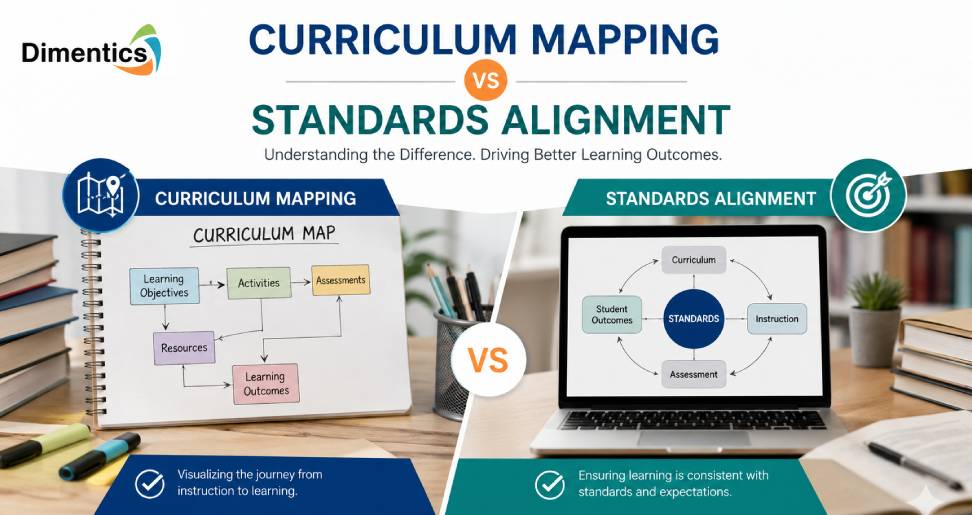
In modern education, creating effective learning content requires more than simply covering topics. Schools, educational publishers, and EdTech companies need to ensure that their curriculum supports clear learning objectives while also meeting applicable academic standards. This is where curriculum mapping and standards alignment become essential.
Although the terms are sometimes used interchangeably, curriculum mapping vs standards alignment represents two related but distinct processes. Understanding the difference can help education organizations improve curriculum quality, identify gaps, strengthen assessments, and prepare learning materials for adoption.
What Is Curriculum Mapping?
Curriculum mapping is the process of organizing and documenting what students are expected to learn, when they learn it, how it is taught, and how learning is assessed.
A curriculum map can provide a structured view of courses, grade levels, learning objectives, instructional resources, assessments, and competencies. It can also reveal gaps, redundancies, and areas where learning experiences may not be sufficiently connected.
For example, a K-12 publisher may map its mathematics content across grades 3 through 8 to determine:
- Which concepts are introduced at each grade level
- Where skills are reinforced
- Which learning objectives are assessed
- Whether important concepts are missing
- Whether similar content is unnecessarily repeated
- How learning progresses from one grade to another
The goal is to create a coherent learning pathway rather than simply produce a collection of individual lessons.
According to the Glossary of Education Reform, curriculum mapping can be used to identify academic gaps, redundancies, and misalignments within a course of study.
What Is Standards Alignment?
Standards alignment focuses specifically on connecting educational content, learning objectives, activities, and assessments to defined academic standards.
In the US K-12 education market, these standards can include frameworks such as the Common Core State Standards (CCSS), Next Generation Science Standards (NGSS), Texas Essential Knowledge and Skills (TEKS), and Florida B.E.S.T.
For example, if a publisher develops a Grade 5 mathematics lesson, standards alignment determines which required academic standard the lesson addresses and whether the content actually provides sufficient coverage of the knowledge or skill described by that standard.
Standards alignment therefore answers a critical question:
“Does this educational content address the required academic standard?”
Dimentics provides standards alignment services for K-12 publishers, EdTech companies, schools, and assessment providers, including standards correlation, curriculum mapping, assessment alignment, gap analysis, and standards crosswalking.
Curriculum Mapping vs Standards Alignment: Key Difference
The simplest way to understand the difference is:
Curriculum mapping organizes the learning journey, while standards alignment verifies its connection to required academic expectations.
Curriculum mapping generally has a broader organizational purpose. It can show how objectives, courses, instructional materials, and assessments fit together across a program.
Standards alignment is more focused on establishing a relationship between educational content and specific standards.
| Curriculum Mapping | Standards Alignment |
|---|---|
| Organizes curriculum components | Connects content to academic standards |
| Shows progression across grades or courses | Verifies coverage of specific standards |
| Identifies gaps and redundancies | Identifies standards coverage gaps |
| Connects objectives, lessons, and assessments | Connects learning materials to standards |
| Supports curriculum planning | Supports compliance and adoption |
| Provides a broader curriculum view | Provides standards-specific evidence |
The two processes work best together rather than separately.
How Curriculum Mapping and Standards Alignment Work Together
A strong educational development process may begin with curriculum mapping and then incorporate standards alignment.
First, the organization establishes the curriculum structure. Learning objectives, units, lessons, competencies, and assessments are organized into a logical sequence.
Next, each relevant component can be reviewed against the required standards. This helps determine whether the curriculum adequately addresses the academic expectations for a particular grade, subject, or jurisdiction.
The process can then identify areas requiring improvement.
For instance, a curriculum may contain excellent lessons about fractions but fail to provide enough practice for a particular grade-level standard. Curriculum mapping can reveal where the concept appears, while standards alignment can show whether the content sufficiently addresses the required standard.
This combination creates a more complete quality-control process.
Why Standards Alignment Matters for K-12 Publishers
For educational publishers and EdTech companies, standards alignment can play an important role in market readiness.
US education standards vary across states and can change over time. Publishers entering multiple markets may therefore need to compare existing content against different standards frameworks.
This is where standards crosswalking becomes valuable. Crosswalking allows organizations to compare requirements across different frameworks and determine how existing content can be adapted.
Dimentics supports this process through Standards Crosswalking, helping organizations compare educational content against multiple state and standards frameworks.
Identifying Curriculum Gaps
One of the most valuable outcomes of mapping and alignment is the ability to identify gaps.
A curriculum gap may occur when:
- A required standard has no corresponding lesson
- A learning objective is introduced but not assessed
- A skill appears at an inappropriate grade level
- Content provides only partial coverage of a standard
- Assessments do not adequately measure the intended learning objective
- Concepts are repeated without meaningful progression
A structured Gap Analysis can help organizations prioritize these issues and determine where additional content, revisions, or assessments may be needed.
Dimentics offers gap analysis as part of its broader curriculum and standards alignment capabilities, helping identify missing standards coverage and areas for improvement.
Assessment Alignment Is Equally Important
Curriculum alignment should not stop with instructional content.
Assessments also need to measure the knowledge and skills students are expected to develop. A lesson may be aligned with a standard, but an assessment that measures unrelated skills can create an alignment problem.
Assessment Alignment Services can help publishers and educational organizations connect quizzes, tests, question banks, and other assessments with appropriate learning objectives and standards.
Dimentics provides assessment alignment as part of its K-12 standards alignment services, helping ensure that assessments correspond with grade-level expectations.
The Role of Metadata and Item-to-Standard Tagging
For digital learning platforms, mapping and alignment can become more scalable when educational resources are systematically tagged.
Metadata tagging and item-to-standard tagging can connect individual learning assets, questions, lessons, or activities with specific standards and learning objectives. This makes content easier to organize, manage, search, and update.
For publishers managing thousands of digital learning assets, structured tagging can also make future standards updates more manageable.
Dimentics offers Metadata Tagging and Item-to-Standard Tagging to help organizations structure educational content around standards and learning taxonomies.
Which One Does Your Organization Need?
The answer is often both.
If your primary goal is to understand how learning objectives, courses, lessons, resources, and assessments fit together, curriculum mapping should be a priority.
If your objective is to demonstrate that content meets specific academic standards, standards alignment is essential.
For publishers preparing content for multiple US states, EdTech companies developing digital learning products, or assessment providers managing large item banks, combining both approaches can provide a stronger foundation for curriculum quality and adoption readiness.
Dimentics combines curriculum strategy, standards alignment, instructional expertise, and quality assurance to support educational publishers, EdTech companies, schools, and assessment providers. Its broader capabilities include Curriculum Mapping Services, Standards Correlation, Standards Crosswalking, Gap Analysis, Assessment Alignment, Third-Party Alignment Review, Metadata Tagging, and State Adoption Submission Support.
Final Thoughts
The debate around curriculum mapping vs standards alignment should not be viewed as an either-or decision. The two processes serve different purposes but complement each other.
Curriculum mapping provides visibility into the structure and progression of learning, while standards alignment establishes whether that learning connects to defined academic expectations.
When combined with assessment alignment, gap analysis, crosswalking, and systematic content tagging, these processes can help organizations develop more coherent, measurable, and adoption-ready educational content.
For organizations looking to scale these activities, working with an experienced education services provider such as Dimentics can provide access to structured workflows, curriculum specialists, subject matter expertise, AI-assisted processes, and quality assurance.
Latest Blog
- Curriculum Mapping Services for U.S. Schools and Educational Publishers
- How to Reduce Corporate Training Costs Without Compromising Learning Quality
- How to Create Interactive Digital Textbooks for K–12 Publishers in the USA
- Scenario-Based Learning Development Services for Corporate Training
- How eLearning Solutions Help Businesses Improve Employee Training and Performance