
Microlearning vs. Traditional E-Learning: Which Drives Better Employee Retention?
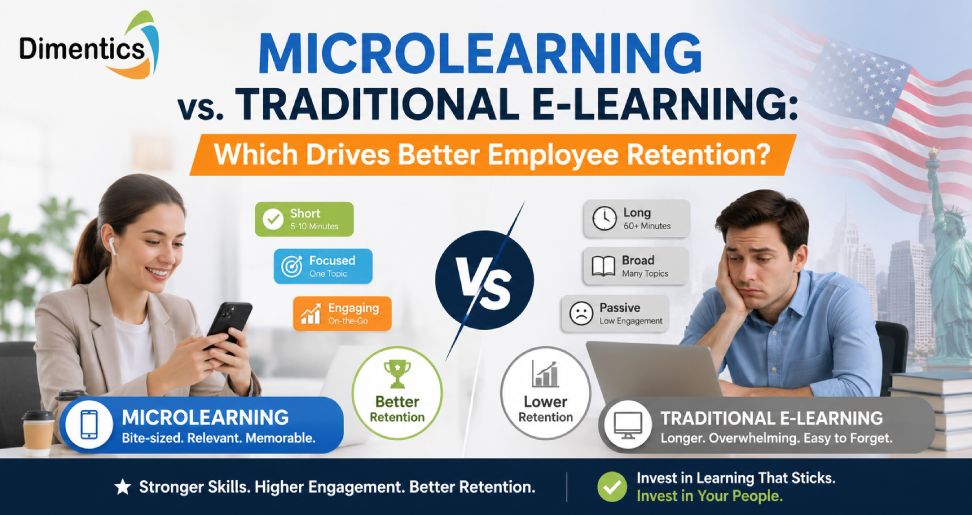
Employee training has evolved significantly over the past decade. As organizations across the United States continue to invest in workforce development, one critical question remains: which learning approach delivers better employee retention—microlearning or traditional e-learning?
With changing workplace dynamics, shorter attention spans, and the increasing need for continuous skill development, companies are rethinking how they train their employees. While traditional e-learning has long been a staple of corporate training programs, microlearning for employee training has emerged as a powerful alternative that aligns with modern learning behaviors.
In this article, we explore the differences between these two approaches, their impact on employee retention, and how businesses can choose the right strategy for their workforce.
Understanding Traditional E-Learning
Traditional e-learning refers to structured online training programs that typically include lengthy modules, presentations, videos, assessments, and certifications. These courses are often designed to provide comprehensive knowledge on a specific topic and may require employees to dedicate extended periods of time to complete them.
Traditional e-learning offers several benefits:
- In-depth coverage of complex subjects
- Standardized learning experiences across teams
- Easy tracking and compliance reporting
- Scalable training for large organizations
However, traditional e-learning also presents challenges. Long training sessions can overwhelm employees, leading to reduced engagement and lower knowledge retention. In today’s fast-paced work environment, employees often struggle to allocate uninterrupted time for lengthy training courses.
What Is Microlearning?
Microlearning is a training approach that delivers information in short, focused learning segments. These lessons typically range from two to ten minutes and focus on a single concept or skill.
Examples of microlearning include:
- Short instructional videos
- Interactive quizzes
- Infographics
- Mobile learning modules
- Quick simulations
- Scenario-based exercises
The growing popularity of microlearning for employee training stems from its ability to provide just-in-time learning experiences that fit seamlessly into employees’ daily workflows.
Rather than requiring employees to complete an hour-long course, microlearning allows them to learn in small increments, making training more accessible and engaging.
The Science Behind Employee Retention
Employee retention in training refers to how effectively employees remember and apply what they have learned over time. Research in cognitive science consistently shows that people retain information better when it is delivered in smaller, manageable chunks.
The concept known as the “forgetting curve” suggests that individuals forget a significant portion of newly acquired information within days if it is not reinforced. Traditional e-learning often delivers large amounts of information at once, making it more difficult for learners to retain key concepts.
Microlearning addresses this challenge by:
- Reducing cognitive overload
- Reinforcing learning through repetition
- Supporting spaced learning techniques
- Encouraging frequent engagement
These characteristics make microlearning particularly effective for improving long-term knowledge retention.
Comparing Engagement Levels
Employee engagement plays a major role in training effectiveness. Even the most comprehensive training program will fail if employees are not actively engaged.
Traditional e-learning courses can sometimes feel overwhelming due to their length and structure. Employees may rush through modules simply to complete mandatory requirements rather than absorb the content.
Microlearning, on the other hand, offers a more dynamic and user-friendly experience. Short lessons are easier to consume, especially on mobile devices, making learning feel less like an obligation and more like an ongoing professional development opportunity.
Organizations that implement microlearning for employee training often report higher completion rates and stronger employee participation compared to traditional learning formats.
Flexibility in Modern Work Environments
The rise of remote and hybrid work has transformed employee learning needs. Today’s workforce requires training solutions that can be accessed anytime and anywhere.
Traditional e-learning programs typically require dedicated learning sessions, which can be difficult to schedule during busy workdays.
Microlearning provides greater flexibility by allowing employees to learn:
- During short breaks
- Between meetings
- While traveling
- At the point of need
This flexibility helps create a culture of continuous learning without disrupting productivity.
For organizations seeking to adapt to modern workforce expectations, microlearning represents a practical and scalable solution.
Cost and Implementation Considerations
Many organizations assume that transitioning to microlearning requires a significant investment. While initial content development may require planning, microlearning can often be more cost-effective over time.
Short learning modules are easier to update and maintain than lengthy e-learning courses. This is especially valuable in industries where regulations, technologies, or procedures change frequently.
Companies such as Dimentics Pvt Ltd recognize the growing importance of agile learning strategies that can evolve alongside business needs. By leveraging modern learning technologies and data-driven training approaches, organizations can deliver more impactful employee development programs while maintaining cost efficiency.
When Traditional E-Learning Still Makes Sense
Despite the advantages of microlearning, traditional e-learning remains valuable in certain situations.
Complex subjects that require extensive explanations, certifications, or compliance training may benefit from longer, structured learning paths. Topics such as cybersecurity, legal compliance, or advanced technical training often require deeper exploration than microlearning alone can provide.
Rather than viewing the two approaches as competitors, many organizations are combining them to create blended learning experiences.
For example:
- Traditional e-learning can introduce foundational concepts.
- Microlearning can reinforce knowledge through ongoing practice and refreshers.
This combination helps maximize both comprehension and retention.
Which Approach Drives Better Employee Retention?
When the primary goal is long-term knowledge retention and learner engagement, microlearning generally outperforms traditional e-learning.
The reasons are clear:
- Shorter lessons improve focus.
- Frequent reinforcement strengthens memory.
- Flexible access encourages continuous learning.
- Higher engagement leads to better completion rates.
However, the most effective training strategies often blend the strengths of both approaches. Organizations that strategically integrate microlearning into broader learning ecosystems can achieve better learning outcomes while supporting diverse employee needs.
As businesses continue to embrace digital transformation, many experts view microlearning as a key component of the future of enterprise learning. Its ability to deliver timely, relevant, and engaging training experiences aligns perfectly with the demands of today’s workforce.
Conclusion
The debate between microlearning and traditional e-learning is not about choosing one method exclusively. Instead, it is about understanding when and how each approach can deliver the greatest value.
For organizations focused on improving employee retention, engagement, and performance, microlearning for employee training offers significant advantages. Its learner-centric design, flexibility, and proven effectiveness make it an increasingly important tool in modern workforce development.
As U.S. companies continue to navigate evolving workplace challenges, adopting a balanced learning strategy that incorporates both traditional e-learning and microlearning can help build a more skilled, productive, and adaptable workforce.
Latest Blog
- AI and Digital Skills Training in the US: Preparing the Workforce for a Digital Future
- Education Content Development Services in US: Building Engaging, Effective Learning Experiences
- Curriculum Alignment vs. Standards Alignment: Which Does Your Education Business Need?
- How to Choose the Right eLearning Content Development Company for Your Organization
- A Complete Guide to Standards Correlation for K–12 Publishers